 中文简体
 English


Wanghe Industrial Park, Qixian Street, Keqiao District, Shaoxing City, Zhejiang Province, China.
If you are trying to decide whether rayon thread is better than polyester for embroidery, here is the short answer: for most machine embroidery work, polyester is the better thread. It breaks less at high stitch speeds, survives repeated washing and sun exposure without losing color, and performs consistently through long production runs. Rayon is the better option only when the finished piece will never face heavy washing, heat, or stress, and when the design depends on rayon's deep, silk-like lustre.
Embroidery thread is the most visible part of any design and also the most stressed one. It passes through the needle at high speed, bends at tight angles, rubs against fabric and machine, and then has to keep looking good through laundering and wear. The fiber you choose determines whether the design still looks crisp after ten washes or whether it fades, fuzzes, or snaps. The sections below set out a direct comparison followed by the practical details that matter when you buy thread.
The Case for Rayon: Where It Genuinely Shines
Rayon embroidery thread is made from regenerated cellulose, usually derived from wood pulp. The process produces a smooth filament with exceptional gloss and a soft, fluid hand. In a side-by-side visual test, rayon often looks deeper and more luxurious than polyester, especially in dense satin stitches and large filled areas. That optical quality is the main reason rayon has not disappeared from the market.
Rayon is also gentler on embroidery equipment. Because the filaments are smooth and less abrasive than polyester, the thread glides through needles and guides with slightly lower friction. Some machines run quieter, and needle-eye issues appear less often. The thread also has a lower melting point and a softer stretch profile, so it tends to sit flat in the stitch rather than spring back.
Rayon makes sense for fashion garments that will be hand-washed or dry-cleaned only, scarves and handkerchiefs, wall art, display pieces that stay out of direct sunlight, and any design where the primary requirement is the appearance of the stitch rather than longevity under hard use.
Its weakness is equally clear. Rayon is weaker than polyester when dry, and significantly weaker when wet. It loses strength at elevated temperatures, so a hot iron or the friction heat of high-speed stitching can damage it. It also has lower colorfastness: rayon dyes are more vulnerable to ultraviolet light and aggressive washing, so a bright red can turn pink after several laundry cycles.
The Case for Polyester: Built for Real-World Embroidery
Polyester embroidery thread is a synthetic strand made from extruded polymer, and its physical profile is the opposite of rayon's. Polyester is stronger, slightly elastic, and stable when wet. When the needle pulls it through dense fabric at high speed, it stretches a little before it breaks, which shows up as a tension problem rather than a sudden thread snap. For that reason, high-speed multi-needle machines run more productively with polyester.
Colorfastness is where polyester separates from rayon most clearly. The dye in most polyester threads is fixed inside the fiber, and in the best products the color is added during spinning using a process called dope dyeing. The result is a thread that survives hot-water washing, dry cleaning, and long sun exposure without significant fading. On items that are laundered frequently, meaning towels, baby clothes, sports uniforms, and hats, this behavior is the difference between a keepsake and a ruined product.
Polyester also handles heat better. It is less likely to scorch under an iron when the garment is finished, and it does not weaken when the needle eye heats the thread during a long run. That makes it the more forgiving thread in a production environment where operators do not have time to fine-tune tensions between designs.
Polyester makes sense for commercial and industrial embroidery, high-speed production, washable garments, children's clothing, outdoor and sportswear, corporate uniforms, and any product that must keep its appearance through many cleaning cycles.
Side-by-Side Comparison
The table below summarizes the differences that affect daily embroidery decisions.
| Property | Rayon (Viscose) | Polyester |
|---|---|---|
| Strength | Moderate; weakens when wet | High; consistent when wet |
| Sheen | Deep, silk-like lustre | Bright but slightly harder gloss |
| Colorfastness | Moderate; fades with UV and washing | Excellent; resists UV, washing, dry cleaning |
| Breakage at high speed | Higher breakage rate | Lower breakage rate |
| Heat resistance | Low; scorches under hot iron or needle | High; tolerates heat well |
| Hand feel | Soft, fluid | Firm, slightly crisp |
| Cost per cone | Often higher | Lower and more stable |
| Best applications | Decorative pieces, fashion, low-wear items | Commercial, high-wear, washable items |
Both threads are available in the same denier range and can be digitized with similar stitch counts. The difference appears after the embroidery leaves the machine.
The Manufacturing Angle: What Determines Thread Performance
The fiber type sets the upper limit of what a thread can do, but the manufacturer decides whether that limit is reached. A well-made polyester thread has three properties that a cheaper cone lacks: consistent denier, balanced twist, and controlled lubrication. If denier varies along the length of the thread, stitch density changes across the design and the embroidery looks patchy. If the twist is not balanced, the thread curls and loops at the needle. If the lubricant is uneven, tension fluctuates and upper thread breaks appear at random points in the run.
For polyester embroidery thread, the specification that most directly affects the result is the denier, written as D/2 because these threads are made from two plies twisted together. The finer 75D/2 is chosen for small lettering and delicate details, 120D/2 is the balanced all-purpose weight, and 150D/2 provides bolder coverage that survives heavy use. A separate article explains what 75D/2, 120D/2, and 150D/2 mean in practice if you need to match thread weight to specific design elements.
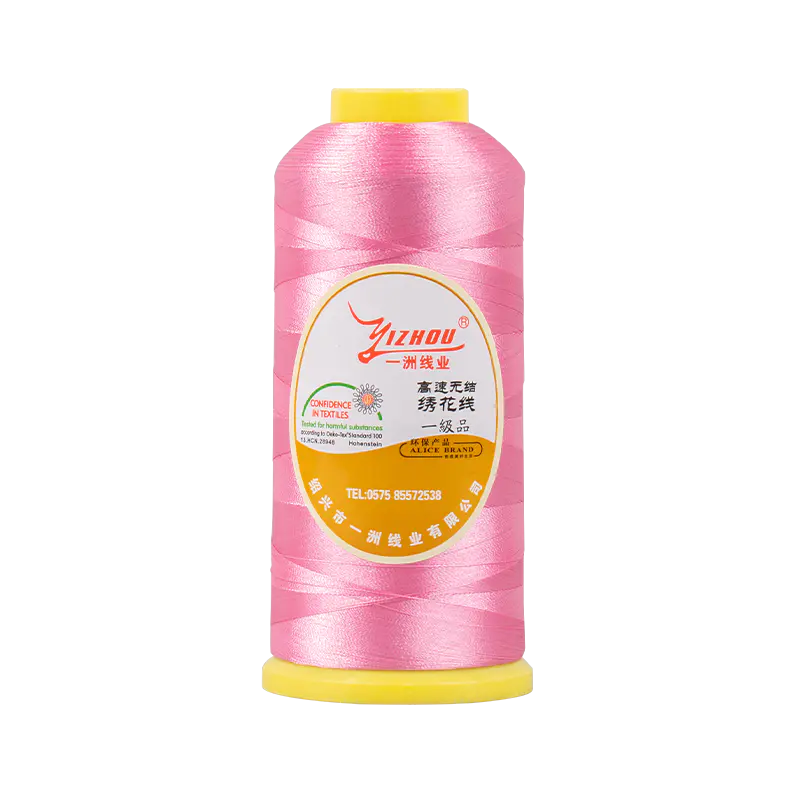 120D/2 Polyester Embroidery Thread for High-Speed MachinesThis balanced all-purpose weight suits high-speed commercial embroidery with smooth feeding and low lint. It is a practical choice for uniforms, apparel, and home textiles where durability and color retention matter.View Product →
A manufacturer that controls these variables can make polyester thread behave almost as softly as rayon while keeping its durability. Shaoxing Yizhou Thread Co., Ltd., a polyester embroidery thread producer in Zhejiang, China, has manufactured polyester embroidery thread since 1998 and exports to more than thirty countries, with annual output above five thousand tons. Its product range includes 75D/2, 120D/2, and 150D/2 in both regular-dyed and dope-dyed versions, which gives production buyers a direct way to compare how construction and color process affect the final stitch.
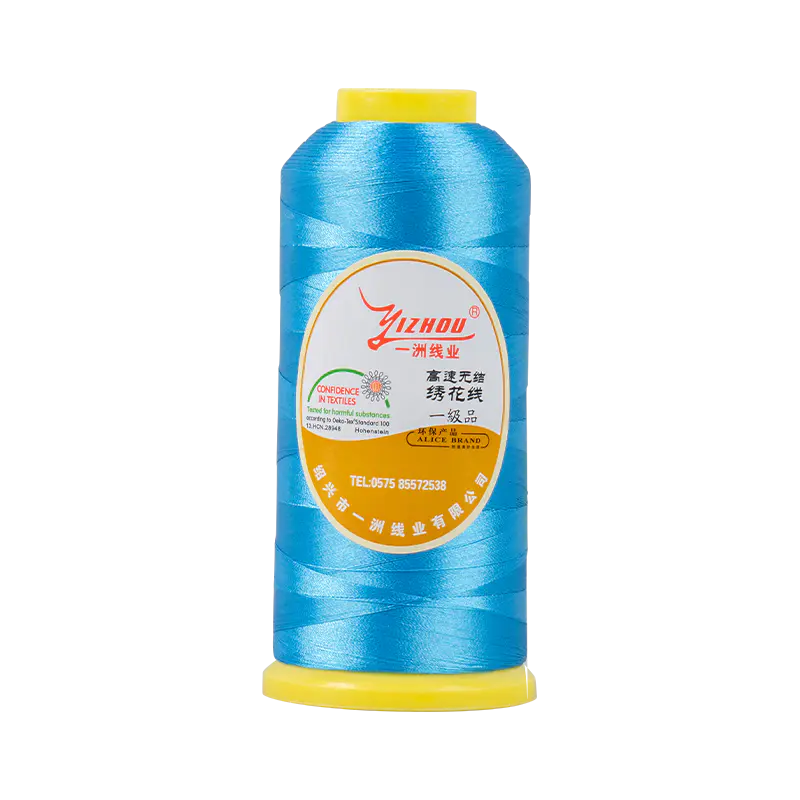 150D/2 Polyester Embroidery Thread for Heavy-Duty DesignsThe thicker denier provides bold coverage and strong abrasion resistance for denim, canvas, and leather. Ideal for caps, patches, and outdoor gear requiring durable, high-impact embroidery.View Product →
How to Choose the Right Thread for Your Project
- High-speed commercial embroidery: choose polyester. Rayon breaks too often under production speeds and tight needle movements.
- Items washed aggressively, including baby clothes, towels, sportswear, and workwear: choose polyester because rayon loses color and strength in hot water and detergents.
- Formal fashion, silk fabrics, wedding pieces, and framed display embroidery: rayon remains a valid choice when the item will not be laundered or exposed to strong sun.
- Branded logos and corporate colors: choose dope-dyed polyester so the color stays within a tight tolerance after many washes.
Color selection matters as much as material. Rayon has historically offered slightly more saturated shades in some color ranges, but modern polyester lines have closed that gap. If your project requires exact color matching and long-term stability, dope-dyed polyester is the safer procurement decision because the pigment is part of the fiber and cannot wash out.
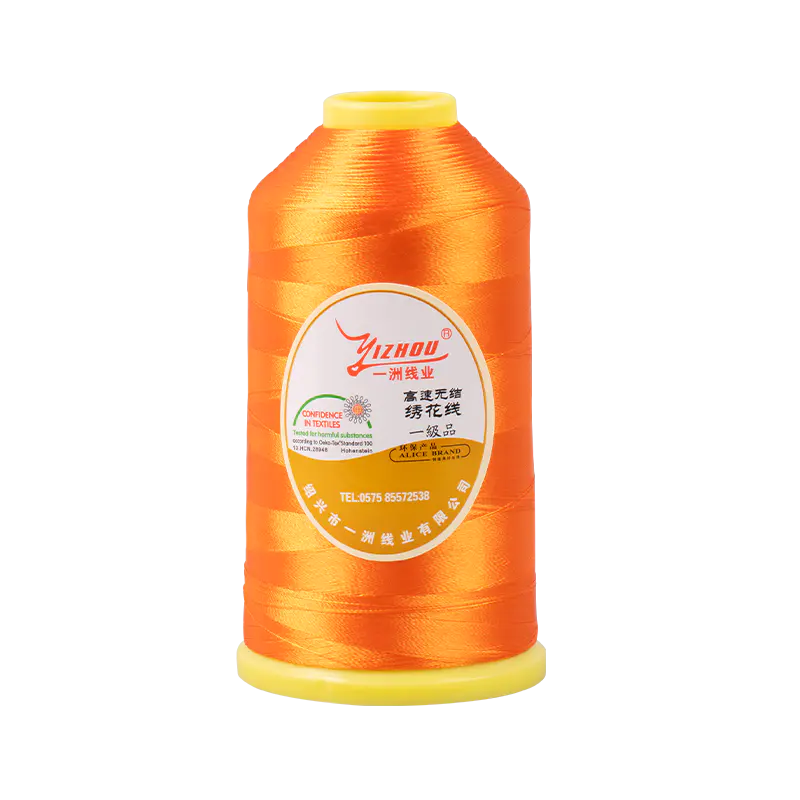 150D/2 Dope Dyed Polyester Embroidery ThreadSolution dyeing locks pigment into the fiber for consistent, fade-resistant color across batches. Suited for premium apparel and accessories, it also reduces water and chemical use in production.View Product →
Practical Buying Tips for Embroidery Thread
Before committing to a full order, test the thread under production conditions rather than in a slow sample stitch. Sew the densest part of your design at your actual machine speed, then put the finished sample through the same washing process the final product will face.
- Stitch at production speed and count the thread breaks over a fixed number of stitches.
- Sew two identical designs, wash one in hot water and one in cold, and compare color, sheen, and stitch integrity.
- Check the cone: the winding should be even, without loose loops, fuzzy patches, or thick-thin areas.
- If you have a micrometer, measure the thread diameter at several points along the cone; consistent diameter means consistent coverage.
These checks matter more than the rayon-versus-polyester label. A premium rayon thread in the wrong application will fail, while a mid-priced polyester thread made to a consistent standard will outperform it in daily use. The practical effects of fiber choice on finished goods are described in more detail in this article on how polyester embroidery thread performs in washing and dry cleaning.
Neither fiber is objectively superior in every situation. If the goal is a decorative piece with the richest possible sheen, and the piece will be handled and stored carefully, rayon still has a legitimate place. If the goal is to embroider products that will be worn, washed, exposed to sunlight, and expected to look the same years later, polyester is the thread you can build a production line around. So the accurate answer to the question is straightforward: for the way most modern embroidery is used, polyester is better, and rayon is better only for the narrow cases where appearance in gentle conditions matters more than durability.