
 中文简体
 English


Wanghe Industrial Park, Qixian Street, Keqiao District, Shaoxing City, Zhejiang Province, China.
You have just received a trial carton of rayon thread for a new decorative embroidery line. The fabric is a soft cotton-linen blend, the design has long satin stitches, and your client wants a glossy finish that looks almost like silk. Your production manager asks the question that every embroidery shop weighs at some point: is rayon better for embroidery than polyester thread?
The short answer is no, not across the board. Rayon offers a softer hand and a sharper, more metallic-looking sheen, but polyester is stronger, more colorfast, and much more predictable in commercial embroidery. Rayon wins only in a narrow set of decorative, low-wear, low-speed applications. For most embroidery work, polyester is the better all-round choice.
This guide compares the two thread families in practical terms: what they are made of, how they behave on the machine, how they survive washing and sunlight, and how your fabric and end use should drive the decision.
Rayon and Polyester: Two Different Thread Families
Rayon thread, also called viscose thread in many markets, is made from regenerated cellulose. The raw material usually comes from wood pulp, which is chemically dissolved, extruded through spinnerets, and then processed into filament yarns. The resulting thread is smooth, bright, and highly absorbent. Its shiny appearance has made it a classic choice for traditional machine embroidery, especially in the fashion and home textile sectors.
Polyester thread, on the other hand, is a synthetic product made from polyethylene terephthalate, the same polymer family used in many textile fibers. It is extruded as a continuous filament, then textured, twisted, and sometimes air-entangled to create the properties needed for embroidery stitching. Polyester can be produced with a bright luster, a semi-dull appearance, or a fully matte finish, which gives it a wider range of visual effects than many buyers realize.
Both thread families have a place on an embroidery production floor. The key is that they do not share the same chemical behavior or mechanical limits, so the question of which is better is really a question of matching the thread to the working conditions.
The Direct Answer: Which Thread Is Better for Embroidery?
For industrial and commercial embroidery, polyester thread is better because it delivers the three things production teams need most: strength, color stability, and consistent running behavior at high machine speeds. Rayon is not a bad thread, but it cannot match polyester in these categories.
Polyester has a higher tenacity, which means it resists breaking when the machine tensions the stitch, when the fabric shifts under the hoop, or when dense designs force the needle through multiple layers. It also has better elastic recovery. A polyester thread can stretch slightly under tension and return to its original length, while rayon is more likely to break abruptly when the needle or fabric creates a sharp impact. This is one reason polyester is the default thread for high-speed and high-density embroidery.
Rayon, nevertheless, remains attractive in one specific way: it reflects light differently. Because rayon filaments are more uniform and have a different refractive index than polyester, they produce a deeper, higher-luster shine. If the embroidery is meant to sit on a garment or accessory that will not be washed aggressively, treated gently, and displayed in a controlled environment, rayon can be the better-looking option. But when you add normal wear, laundering, chlorine, UV exposure, and production-speed demands, polyester is the more reliable and more economical choice.
Property-by-Property Comparison
To make a fair comparison, look at each thread separately across the properties that affect embroidery quality and long-term durability. The table below summarizes the practical differences between rayon and polyester embroidery thread.
| Property | Rayon / Viscose Thread | Polyester Thread |
|---|---|---|
| Tensile strength | Weak to moderate; breaks more easily under shock loading | High; resists breaking under tension and rapid force |
| Wet strength | Loses significant strength when wet | Retains strength when wet |
| Elasticity | Low stretch; limited recovery before breakage | Good stretch with better recovery |
| Abrasion resistance | Moderate; can wear down during dense stitching or rough handling | High; suited to frequent handling and wear |
| Sheen | Deep, silk-like gloss | Bright to semi-dull, depending on finish |
| Hand feel | Soft, smooth, drape-like | Slightly crisper, though still smooth |
| Colorfastness to washing | Good in cool water, but fades with repeated washing | Excellent, even at warm and hot washing temperatures |
| Lightfastness | Moderate; fades with prolonged daylight or strong artificial UV light | Excellent; retains color better in sunlight |
| Chemical resistance | Damaged by bleach, chlorine, and some stain removers | Resists chlorine and common laundry chemicals |
| Machine wear | Less abrasive to needle and machine parts | Can dull needles a little faster because the filament is tougher |
| Cost per cone | Usually lower in raw price, but more waste from breaks and re-stitching | Often slightly higher, but lower production cost per good stitch |
The most important line in this table is wet strength. Rayon loses strength when wet, which means a beautifully embroidered shirt with a rayon logo can be damaged by perspiration, rainy weather, or a warm washing cycle. Polyester does not have this weakness. For any garment that will be worn, washed, folded, packed, or exposed to the environment, polyester immediately becomes the safer choice.
Machine wear also deserves attention. Many operators report that rayon is less abrasive to needles and machine parts than polyester, which is why some old-style embroidery rooms preferred rayon for a smoother running feel. This advantage, however, is small compared with the cost of thread breaks and repairs caused by rayon's lower strength.
When Rayon Is the Better Choice
Rayon is not outdated, and it is not always the wrong choice. In specific contexts, rayon's weaknesses become irrelevant and its appearance becomes the deciding factor.
Rayon is the better choice when the embroidered item will be handled like a delicate piece of textile art. Examples include:
- Framed embroidery wall art that hangs indoors and is never laundered.
- High-fashion runway garments that may be worn a few times and then become vintage pieces.
- Embroidered handkerchiefs, scarves, or table linens that receive gentle hand washing in cold water.
- Couture clothing made from fine natural fibers such as silk, cotton voile, or linen, where a soft hand is essential to the fabric's drape.
- Slow-speed or hand-guided embroidery, where the operator can control tension and reduce the risk of thread shock.
Rayon also produces a distinctive luster that is difficult to imitate with polyester. If your client specifically asks for a "wet look" or a mirror-like shine that catches light at sharp angles, rayon can deliver that effect more readily than a standard polyester thread. Some digitizers prefer rayon for long satin stitches because the thread lies flatter and the light reflects over a longer continuous surface.
The important rule with rayon is to protect it. Rayon embroidery should not be treated with bleach, exposed to intense sunlight for long periods, or washed in hot water. If you can control those factors, rayon's beauty can be preserved.
When Polyester Is the Better Choice
Polyester becomes the clear winner as soon as the embroidery enters a normal commercial environment. This includes almost everything that leaves a production facility and goes into daily use: uniforms, corporate apparel, polos, caps, bags, denim, children's wear, sportswear, towels, and outdoor equipment.
High-speed commercial embroidery machines run at speeds that require a thread with consistent friction, predictable elongation, and high breaking strength. Polyester handles these conditions better than rayon. Because polyester stretches before it breaks, the machine can absorb momentary tension spikes without causing a thread break that stops the needle and creates rework. In a busy embroidery shop, a 2 percent reduction in thread breaks can save more money than the difference in cone prices.
Washing performance is another area where polyester dominates. A polyester thread can be washed at 60 degrees Celsius or higher, bleached, dried in a tumble dryer, and still hold its color. Rayon embroidery, by comparison, can shrink slightly, lose strength, and show color fading after repeated wash cycles. Workwear, school uniforms, hotel linens, and baby clothing all require this level of wash resistance.
Outdoor exposure is also a polyester strength. Polyester resists UV degradation far better than rayon. For embroidered headwear, boat covers, awnings, sports uniforms, and summer clothing, polyester thread keeps its color and structure through prolonged sunlight. Rayon will lose color and eventually weaken, which can cause the design to crumble or shred over time.
For a deeper look at how polyester performs in different cleaning environments, our review of polyester thread washing and dry-cleaning behavior covers the test conditions and practical results in more detail.
Thread Size and Construction: 75D/2, 120D/2, and 150D/2
Another factor that determines whether rayon or polyester is better is the thickness of the thread. Embroidery threads are usually described by their denier and ply. Denier tells you how heavy the yarn is. A 75D thread is fine, a 120D thread is medium, and a 150D thread is heavier. The suffix /2 means the thread is made from two plies twisted together.
The same denier will perform differently depending on whether the material is rayon or polyester. A 75D/2 rayon thread is very fine and produces delicate detail, but it is also weaker than a 75D/2 polyester thread. For a small letter set on a soft cotton blouse, a fine rayon can be gorgeous. For the same letter set on a company uniform that will be washed repeatedly, a fine polyester thread is stronger and more durable.
The 120D/2 size is the best-selling general-purpose embroidery thread for good reason. It balances coverage, flexibility, and compatibility with a wide range of designs and fabrics. A 120D/2 polyester thread can replace a slightly heavier rayon thread in many cases because the polyester adds strength without requiring a thicker stitch line.
The 150D/2 size is used for bolder designs, larger lettering, and thicker fabrics. When the design has heavy fills or dense underlay, the thread must stand up to high needle-heat and repeated penetration. Polyester 150D/2 is the most dependable option in this category. Rayon 150D/2 may look soft and luxurious, but its lower strength makes it more vulnerable to breakage in dense production work.
If fine detail is your main need, a polyester 75D/2 thread gives you the narrow stitch profile and strength that rayon struggles to match.
 75D/2 Polyester Embroidery Thread for High-Density Detail WorkThis ultra-fine polyester thread is suited for intricate embroidery on delicate fabrics like silk and organza, offering strength and a flat stitch profile for clean, precise lines in micro-lettering and lace.View Product →
For most all-purpose production work, a 120D/2 polyester thread offers the best balance between visibility, flexibility, and color performance.
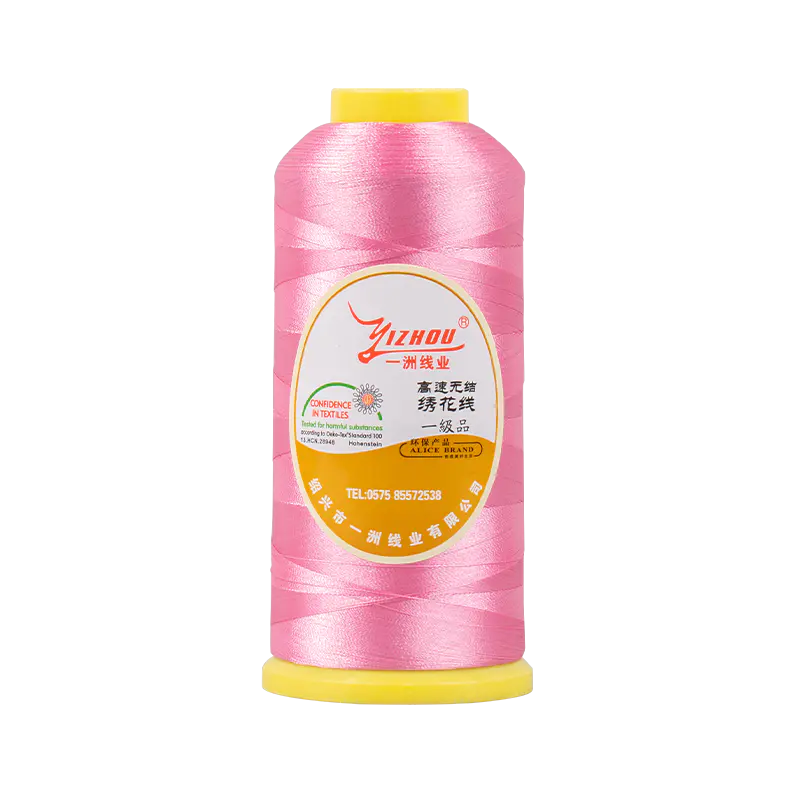 120D/2 Polyester Embroidery Thread for High-Speed ProductionAs the most widely used specification, it balances strength and coverage for commercial machines, reducing friction and lint while maintaining vibrant, durable results on uniforms, tees, and sportswear.View Product →
The issue of thread construction also explains why some shops keep both materials in stock. A shop that mostly embroiders caps and jackets may use 150D/2 polyester for structured designs and 75D/2 rayon for a premium look on linings or labels. Understanding the denier system makes it easier to switch between materials without losing the expected stitch coverage.
Color: Dyeing Methods, Dope-Dyed Polyester, and Color Consistency
Rayon is known for taking dye well and producing deep, saturated colors. Because rayon is cellulose-based, it absorbs many classes of dyes easily, particularly direct and reactive dyes. This makes it possible to achieve vivid jewel tones and rich blacks with a soft, natural feel. The downside is that some of those dyes are less stable in washing and sunlight than the disperse dyes used on polyester.
Polyester is hydrophobic, meaning it repels water and does not absorb ordinary dyes easily. It must be dyed at high temperatures with disperse dyes. This difficulty in dyeing is actually an advantage in performance: once the dye is inside the polyester fiber, it is difficult to wash out. As a result, polyester thread usually has better colorfastness than rayon.
For buyers who require extremely high color consistency across production batches, dope-dyed polyester is an even better option. Dope-dyed, also called solution-dyed or original-colored, means the color pigment is added to the polymer before the filament is extruded. The pigment becomes part of the thread itself rather than being applied to the surface. This creates strong color stability against washing, chlorine, sunlight, and industrial cleaning chemicals.
If your customer expects a fabric brand color to remain identical after a 75 degree Celsius wash, or if the embroidery will be exposed to outdoor sunlight, a dope-dyed polyester thread is more reliable than a traditionally dyed rayon thread. Dope-dyed polyester also reduces the environmental impact of dyeing because there is no separate dye bath and less water consumption.
The 150D/2 dope-dyed polyester grade is a common choice for high-end embroidery where color permanence matters as much as appearance.
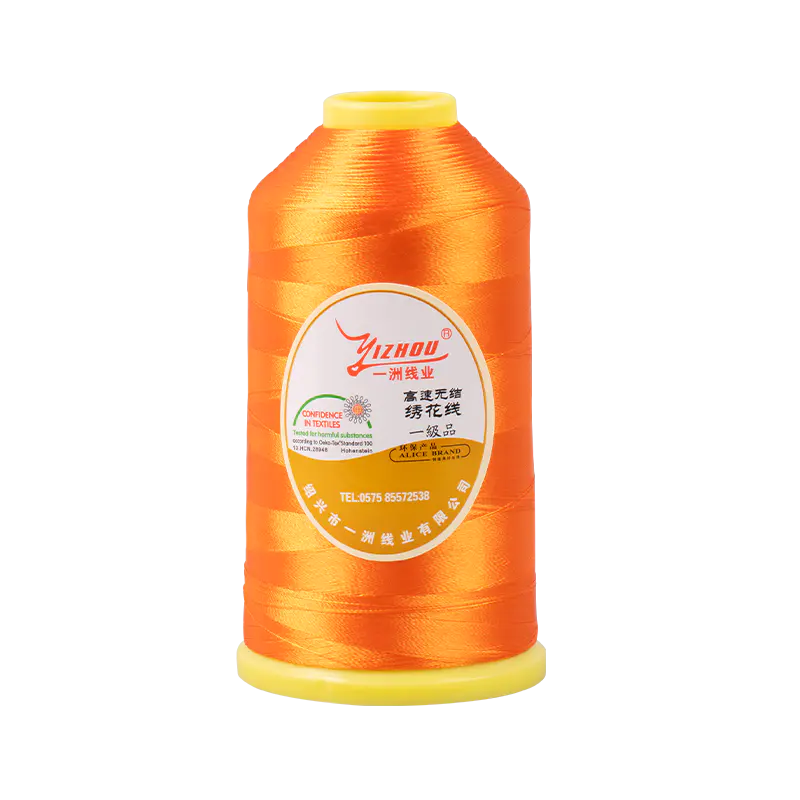 150D/2 Dope-Dyed Polyester Embroidery Thread with Fade-Resistant ColorThis dope-dyed grade embeds pigment into the fiber before spinning, ensuring consistent shade and high colorfastness. It suits premium apparel and branded products where long-term visual quality is essential.View Product →
For a full discussion of how dope-dyed technology changes the embroidery color story, our explanation of dope-dyed polyester thread in textile production shows why this option has become a procurement standard in many embroidery facilities.
Quality Control and Practical Testing for Buyers
Whether you choose rayon or polyester, the real quality lies in the manufacturing details. A poorly made polyester thread will perform worse than a well-made rayon thread, even if polyester is the stronger material. Buyers should evaluate thread based on measurable specifications, not just the raw material name.
Tensile Strength and Elongation
Ask the supplier for the breaking force and elongation percentage of each batch. Tensile strength is usually expressed in grams or newtons. Elongation is expressed as a percentage of the thread length at break. For machine embroidery, a thread with moderate elongation, between 15 and 25 percent for polyester, is generally better than one with very low elongation. Low elongation means the thread snaps when the fabric shifts suddenly.
Twist Balance
Embroidery thread must be twisted in a balanced way. If the twist is too tight, the thread will curl and cause loops or bird nests. If the twist is too loose, the thread will lose cohesion and produce poor stitch definition. Ask the supplier for the twist-per-meter specification or run a simple loop test: pull a length of thread from the cone, pinch it between your fingers, and let it hang. A balanced thread will hang straight with only a slight curl.
Colorfastness and Washing Tests
Request test reports for washing, rubbing, and light exposure. Common references include ISO 105-C06 for domestic and commercial laundering, ISO 105-B02 for artificial light, and ISO 105-X12 for colorfastness to rubbing. A polyester thread should show minimal color change in a 60 degree Celsius wash with bleach. Rayon may pass a cold-water test but fail a hot wash with detergent and bleach.
Do not rely only on the supplier's specification sheet. Run a practical trial on the actual fabric you intend to embroider. Embroider a test piece at the same machine speed, with the same needle size and design density, and then wash it the same way your customer will. Measure thread breaks, skipped stitches, color change, and edge definition before making a bulk purchase.
Needle Heating and Friction
At high speed, a needle becomes hot from friction with the thread and fabric. Polyester has a higher melting point than rayon, so it handles needle heat more safely. Rayon can dry out, become brittle, and break if the needle overheats. This is another reason why polyester is often preferred for dense designs in thick materials.
Weight Consistency
Check that the dealer or manufacturer supplies the exact denier you asked for. A small deviation from the nominal denier can affect stitch coverage and cause shading differences in large areas. A reliable embroidery thread manufacturer will test the linear density and report the actual measured denier on each lot.
Purchasing and Supplier Considerations for Embroidery Businesses
Once you know which material is right for a job, the next challenge is buying it from someone who can supply it consistently. This is where thread material selection meets supplier selection. The best decision between rayon and polyester is still a bad decision if the supplier cannot guarantee stable quality across orders.
Cost per Stitch versus Cost per Cone
Rayon tends to be priced lower per cone in some markets, but the true cost of an embroidery thread is the cost per good stitch. Thread breaks, re-punching, downtime, and rejected garments all increase unit cost. Polyester may cost a little more per kilogram, but its strength and consistency reduce waste. For a high-volume shop, polyester frequently becomes the lower-cost option in total production terms.
Dye Lot Consistency
Whether you buy rayon or polyester, shade variation between dye lots is a constant purchasing risk. A thread that does not match the previous batch can force you to scrap an entire run of caps or uniforms. Buyers should ask suppliers how they manage dye lot continuity and whether they keep extra cones from the same production batch.
Packaging and Cone Size
Production efficiency also depends on the cone size and package uniformity. A cone with defects in winding will cause tension variations and thread breaks. Ask for the nominal length or weight per cone, the winding process, and the maximum usable portion of the cone. Reputable suppliers usually indicate these details in their technical data sheet.
Technical Support and Samples
A thread manufacturer that sells only a catalog and cannot answer technical questions is risky for an embroidery operation. Good suppliers can recommend the correct thread size, material, and finish for your fabric, machine model, and design density. They can also provide pre-production samples for wash testing and needle testing.
Certifications and Traceability
For apparel sold into European and North American markets, traceability is increasingly important. Buyers should ask about third-party certifications and supply chain documentation. A manufacturer that can show consistent quality records, process control, and source materials with documented properties is preferable to one that offers only low prices.
Final Verdict: A Balanced Thread Room Is the Best Long-Term Solution
So, is rayon better for embroidery than polyester thread? No, not in the way most embroidery businesses need to think about it. Polyester is the more durable, more colorfast, and more production-friendly material. It handles high-speed machines, aggressive washing, sunlight, and dense designs without sacrificing quality. For 80 to 90 percent of commercial embroidery work, polyester should be the default.
Rayon deserves a smaller but still meaningful place in the thread room. Use it when the appearance absolutely must have that deep, silk-like shine that rayon is known for, and when the end product will be protected from hard use. A high-end scarf, a framed decorative panel, or a wedding garment can all justify rayon thread. Just understand its limits: rayon requires gentler washing, lower machine speed, and cleaner production conditions.
The best embroidery operation does not treat this as a binary battle. Instead, it builds a thread inventory that includes both materials in different sizes and finishes, and it chooses deliberately based on the fabric, the design, the care instructions, and the customer's actual expectations. Polyester for the hard-working products, rayon for the special decorative pieces, and dope-dyed polyester for the projects that demand long-term color stability. That balanced approach gives you the beauty of both thread families while avoiding the production and durability problems that come from choosing the wrong one.
Before you place your next order, make a simple list: what will your customer do with the garment, how will it be washed, and at what speed will you produce it? If the answer includes washing, sunlight, heat, or full-speed production, choose a high-quality polyester embroidery thread. If the answer puts presentation ahead of washing and use, keep rayon in your color card for that rare, beautiful project.