 中文简体
 English


Wanghe Industrial Park, Qixian Street, Keqiao District, Shaoxing City, Zhejiang Province, China.
A production embroidery room is not kind to thread that breaks, snags, or fades after a few washes. Many embroiderers still reach for rayon because of its glossy, silk-like look, but the practical difference between rayon and polyester embroidery thread comes down to this: rayon looks softer and more traditional, while polyester is stronger, more colorfast, and more predictable on high-speed machines. This article compares the two fibers by composition, strength, colorfastness, UV resistance, luster, cost, and the real-world question of which thread should go into a commercial embroidery machine.
What Is Rayon Embroidery Thread?
Rayon is a regenerated cellulose fiber. Wood pulp or cotton linters are dissolved with chemicals, extruded through spinnerets into continuous filaments, and then twisted into thread. Because the starting material is plant-based but the manufacturing process is chemical, rayon is usually described as a semi-synthetic fiber.
On the spool, rayon shows a soft, silky luster and a flexible hand feel. It dyes to deep, rich colors, which made it the classic choice for decorative and vintage-style embroidery. But cellulose absorbs water easily. Rayon loses a large share of its strength when wet, fades faster in sunlight, and does not tolerate heat or chlorine well. Those limitations become obvious once an embroidered garment goes into a washing machine.
What Is Polyester Embroidery Thread?
Polyester is a fully synthetic fiber made from polyethylene terephthalate (PET), a petroleum-derived polymer. The polymer is melted, extruded through spinnerets, drawn, and twisted into smooth continuous filaments. Commercial polyester embroidery threads are normally two-ply, offered in specifications such as 75D/2, 120D/2, and 150D/2, where D stands for denier and /2 means two plies twisted together.
Polyester was engineered to fix the weaknesses of cellulosic fibers. It is strong whether dry or wet, absorbs almost no moisture, does not shrink, and keeps consistent tension at high machine speeds. It holds color in tightly controlled dye lots, resists UV light, and survives chlorine bleach, industrial laundering, and dry cleaning. Its luster can be adjusted from bright to semi-dull to fully matte, so it no longer has to look shiny or artificial.
Key Differences at a Glance
| Property | Rayon | Polyester |
|---|---|---|
| Fiber base | Regenerated cellulose from wood pulp | Synthetic PET polymer from petroleum |
| Dry tensile strength | Moderate | High |
| Wet tensile strength | Loses 30-50% of strength when wet | Retains nearly all strength when wet |
| Moisture absorbency | High, about 11-13% moisture regain | Very low, around 0.4% |
| UV and sunlight resistance | Poor, fades and weakens | Good, holds color and fiber integrity |
| Colorfastness in washing | Moderate, can bleed over many cycles | High, survives repeated laundering |
| Luster | Soft, silk-like sheen | Engineered from matte to high-gloss |
| Typical use | Decorative pieces, light wear, limited washing | Commercial machine embroidery, apparel, frequent washing |
Strength and Durability: What Actually Breaks
In machine embroidery, thread passes through the needle eye, tension discs, and metal surfaces several hundred times per minute. Rayon tolerates that friction for a while, but its abrasion resistance is lower and it breaks more easily under tension. When the thread gets wet, the gap widens: rayon loses roughly 30 to 50 percent of its strength when saturated, while polyester keeps almost all of it.
Why wet strength matters
Embroidered items get washed. Rayon swells as it absorbs water, weakens, and gradually frays; polyester keeps its tensile rating and its stitches intact. For dense logos on backpacks, workwear, or towels, polyester's abrasion resistance also protects the design under heavy use. On a production line, switching from rayon to polyester typically means fewer thread breaks per thousand pieces, fewer machine stops, less re-hooping, and the freedom to run dense designs at higher speeds.
Colorfastness, Washing, and UV Resistance
If a thread cannot keep its color, nothing else matters. Rayon dyes beautifully, but its colorfastness in home washing is only moderate, and ultraviolet light breaks down both the fiber and its dyes. Polyester holds dye inside the polymer structure, and reputable manufacturers control their dye lots tightly, so shades stay consistent from cone to cone and from batch to batch.
Polyester also survives chlorine bleach and high-temperature washing, which is why apparel brands choose it for denim, sportswear, and uniforms. For detailed test data, see how polyester embroidery thread performs in washing and dry cleaning.
For the highest level of color permanence, dope-dyed polyester goes one step further: the pigment is added before the thread is spun, so the color runs through the entire filament and cannot be washed out.
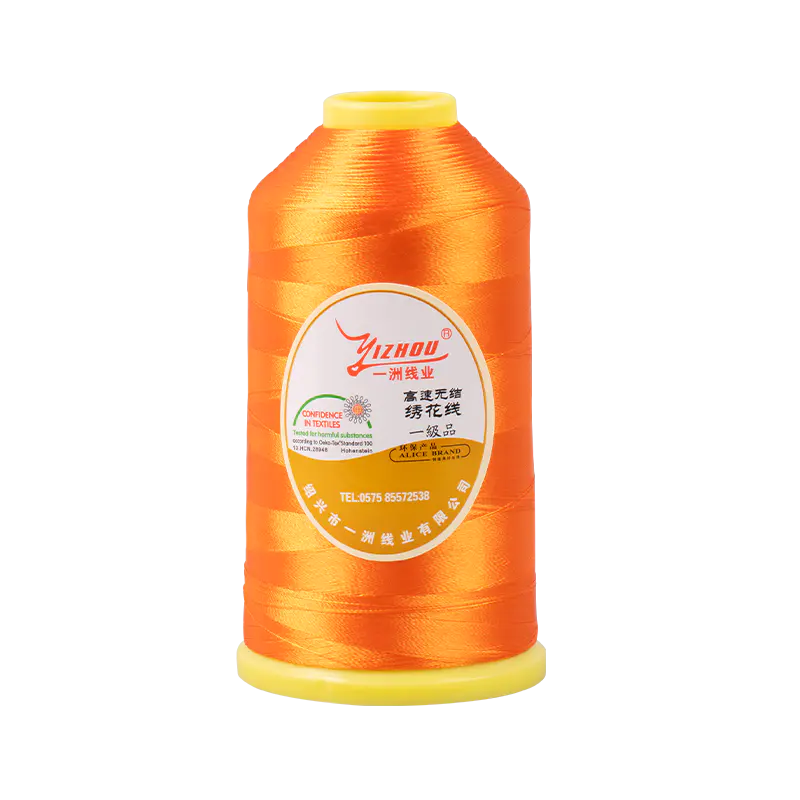 150D/2 Dope-Dyed Polyester Embroidery Thread for Colorfast DesignsThis solution-dyed polyester thread offers embedded pigments that resist washing and friction, making it a strong candidate for projects where long-term color retention and consistent shade are essential.View Product →
Luster and Appearance: Where Rayon Still Has a Place
Rayon's soft, silk-like luster is its strongest argument. For bridal wear, velvet, and decorative pieces that sell on finish rather than wash durability, that sheen is hard to beat. Rayon also lies flatter on the fabric and feels more flexible at lower sewing speeds, which some embroiderers prefer for lightweight goods. Trilobal polyester filaments can produce a sheen close to silk, so designers are not limited to dull synthetics.
Even so, a matte-finish polyester still withstands washing, sunlight, and friction that would eventually dull rayon. If the final product is framed art that will never be laundered, either fiber works. If it is clothing, choose polyester and let the luster be controlled by the thread finish rather than by sacrificing durability.
Environmental and Cost Considerations
Rayon starts from renewable wood pulp and degrades naturally, but the viscose process uses chemicals and the short product life means the garment is replaced sooner. Polyester is petroleum-based and does not biodegrade, yet it is recyclable, and dope-dyed polyester eliminates an entire wet dyeing step, which saves water, energy, and chemical discharge at the mill.
On cost, raw prices per cone are comparable, but total cost of ownership is what matters in production. Polyester breaks less, so machines stop less often, thread waste drops, rework falls, and fewer finished garments are rejected. In bulk embroidery, that difference pays for itself quickly.
How to Choose: 75D/2, 120D/2, or 150D/2
Once the rayon-versus-polyester question is settled, thread size is the next decision. Lower denier means a finer thread, and the /2 suffix indicates two plies, which adds strength without excessive bulk. The standard commercial range is 75D/2, 120D/2, and 150D/2.
Choose 75D/2 when the design contains small lettering or fine details, or when the fabric is lightweight, such as silk, chiffon, or fine cotton. The finer body keeps the design readable and leaves a soft hand feel on the finished piece.
 75D/2 Fine Polyester Embroidery Thread for Delicate FabricsAn ultra-fine thread engineered for high-density stitching on silk, organza, and micro-lettering, providing clean lines and a soft hand feel while reducing bulk in intricate patterns.View Product →
For most daily production, 120D/2 is the balanced workhorse. It carries enough thickness to cover a design cleanly while staying fine enough for detailed logos on knit polo shirts, woven shirts, and medium-weight home textiles.
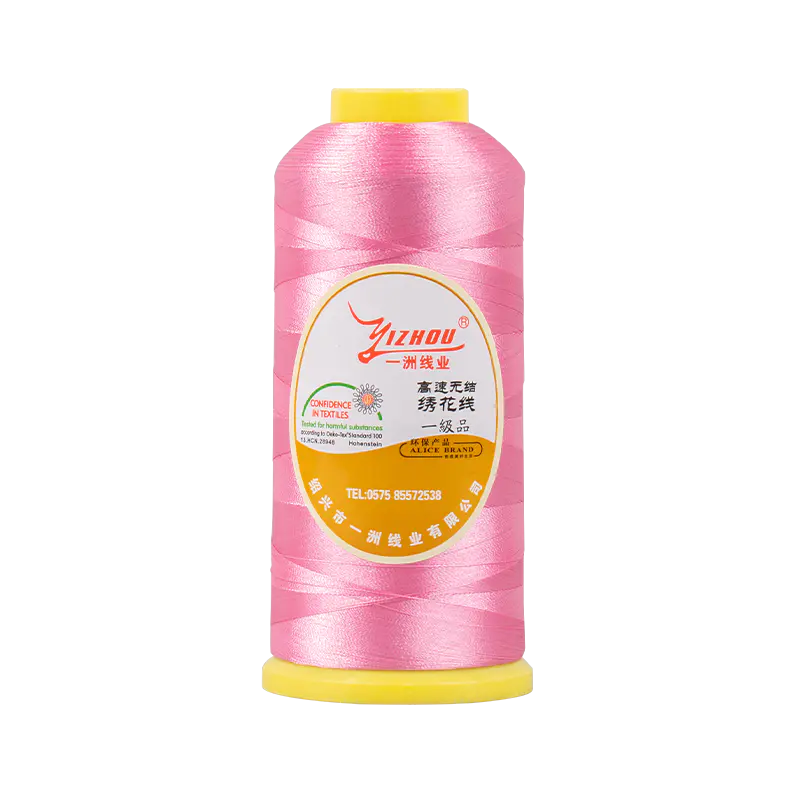 120D/2 Balanced Polyester Embroidery Thread for High-Speed ProductionA widely used specification that balances strength and coverage, featuring advanced lubrication for smooth feeding on commercial machines, ideal for uniforms, polos, and frequent washing.View Product →
150D/2 is the heavyweight option. Use it for dense fill patterns, caps, denim, canvas, towels, and upholstery, where the design meets abrasion and frequent washing. The thicker body fills areas in fewer passes and adds a raised, dimensional look that customers often associate with premium embroidery.
For a full comparison of these three specifications, see our guide to 75D/2, 120D/2, and 150D/2 polyester embroidery threads.
The Bottom Line
Choose rayon when the design truly needs a silk-like luster, the item will not be washed repeatedly, and the embroidery runs at moderate speed. Choose polyester when you need strength, color that survives washing and sunlight, consistent tension on high-speed machines, and predictable output. For most commercial embroiderers, apparel brands, and contract stitching shops, polyester is the right answer for the majority of their work.
When you evaluate suppliers, ask about dye-lot consistency, breaking strength, and whether the factory controls quality from raw yarn to finished thread. These factors determine how smoothly your production line runs and how long your embroidery keeps its appearance.