
 中文简体
 English


Wanghe Industrial Park, Qixian Street, Keqiao District, Shaoxing City, Zhejiang Province, China.
You have a lace design sitting on the screen — an edging for a wedding veil, a freestanding motif for a blouse yoke, or a repeat pattern meant for tulle. You have also read plenty of traditional advice that mentions silk for fine lace, rayon for shine, and cotton for vintage charm. But the cones on your rack are polyester, and the customer's order needs to go out this week. Can you use polyester thread for lace machine embroidery without compromising the result?
Yes. The honest, practical answer is that polyester thread is not merely an occasional substitute for lace machine embroidery. For most commercial lace work, it has become the standard choice. Lace is demanding in ways that ordinary embroidery is not: the stitch counts are higher, the base materials are finer, the open structure leaves every thread visible, and the finished pieces often need to survive washing, sunlight, and even chlorine exposure. Polyester handles those demands better than any other common embroidery fiber.
That does not mean every polyester thread will perform identically. The denier, the luster, the twist, and the dye method all determine whether the lace drapes softly, keeps its edges, and resists fading. Thread weight, machine settings, stabilizer choice, and supplier quality matter just as much as the fiber itself.
This article walks through the practical side of using polyester thread for lace machine embroidery: what lace processes require from the thread, how to choose between 75D/2, 120D/2, and 150D/2, how to adjust needles and tension on multi-head and Schiffli machines, how to handle water-soluble stabilizers, what to expect in laundering and color stability, and which supplier quality checks prevent downtime on a production lace run.
What Lace Machine Embroidery Demands from a Thread
Lace machine embroidery is not one single process. The practical situations that bring embroiderers to this question include freestanding lace stitched entirely on water-soluble film, chemical lace produced on Schiffli looms, and embroidery applied directly onto tulle, net, or other open-weave grounds. All three share a common set of demands on the thread, and a thread that fails any one of them will cause problems that no design file can fix.
The first demand is fineness. A lace motif is a network of small stitches arranged to create a pattern and open space. A heavy thread fills the open areas with stiffness and bulk, and it turns a light, floating lace into a heavy fabric panel. The second demand is strength. Industrial lace machines run at high speeds, commonly 750 to 1,200 stitches per minute, and dense satin stitches change direction rapidly. The thread is pulled, twisted, and flexed thousands of times in a single garment, so it needs consistent tensile strength and enough elongation to absorb the motion without snapping. The third demand is smoothness. Any nub, knot, slub, or clump of loose fibers becomes a jammed needle, a skipped stitch, or a visible flaw in an open structure that cannot hide behind dense fill. The fourth demand is tolerance for finishing. Lace pieces are usually washed, dissolved out of stabilizer, pressed, and sometimes bleached, so the thread must hold its color and physical integrity through warm water, detergent, and heat. The fifth demand is appearance. White and pastel lace must read as clean and elegant, not dull, yellowed, or plastic-like.
Polyester satisfies these requirements, and it does so with fewer compromises than the traditional alternatives. The central structural fact is that most polyester embroidery threads are multifilament continuous yarns, not spun staple yarns. A continuous filament has no short fiber ends poking out to create lint, no weak points where individual fibers slip past one another, and a nearly perfect diameter uniformity along the full length of the cone. That is exactly what a needle running at high speed through fine lace fabric needs.
Luster also matters in lace, more than in most embroidery. Lace is often white-on-white or applied over a contrasting ground, so the way the thread reflects light defines the design. Polyester's luster is adjustable at the spinning stage: round cross-section filaments produce a more matte surface, while trilobal filaments have three-lobed cross sections that reflect light softly, in a way similar to silk. For bridal lace, trilobal bright polyester is frequently specified because it reads as luminous without the hard gloss of some metallics. This control is another reason why polyester has displaced rayon in lace lines: lace buyers do not have to choose between durability and shine.
| Property | Polyester | Rayon (viscose) | Cotton |
|---|---|---|---|
| Wet strength | High | Low; loses roughly half its strength when wet | Moderate |
| Colorfastness in warm-water washing | Excellent, minimal fading | Prone to color bleed and dulling | Depends on dye class and finish |
| Resistance to chlorine bleach | Good fiber resistance | Poor; bleach degrades the fiber | Poor for both color and fiber |
| Lint generation | Very low because it is continuous filament | Low to moderate | High; short fibers shed and clog needles |
| Dimensional stability when wet | Low moisture absorption, little swelling | High moisture absorption, noticeable swelling | Moderate |
| Luster control | Wide range through trilobal cross-sections | High natural sheen | Low unless mercerized |
The decisive difference is wet behavior. Rayon has a beautiful sheen and a long history in lace, but it loses a large share of its tensile strength when wet and cannot tolerate aggressive laundering or hot water. Cotton produces lovely matte lace, yet its short fibers shed lint that accumulates in needle eyes during dense satin stitching. Polyester, being hydrophobic, does not swell when washed, does not lose strength when saturated, holds its color across repeated launderings, and runs clean at high speed. That combination is why polyester lace embroidery thread dominates high-volume commercial work today.
Choosing the Right Thread Weight for the Lace Effect
Once you accept that polyester belongs on a lace machine, the next decision is linear density, which in practical terms means how thick the thread is. Polyester embroidery threads are commonly labeled with a denier number and a ply count. The letter D stands for denier, the weight in grams of 9,000 meters of a single strand. The /2 means that two strands are twisted together. A 75D/2 thread, for instance, is made of two 75-denier strands, so it runs at about 150 denier in total. A 120D/2 thread totals roughly 240 denier, and a 150D/2 thread totals about 300 denier.
This distinction is not a specification detail for engineers only. In lace, thread thickness controls three visual and physical properties at the same time: how fine the pattern reads from a distance, how much the lace drapes over a curved surface, and how strong the individual stitches are. A thinner thread creates an airy, delicate look and a soft hand, but it also delivers less coverage per stitch, so dense areas need slightly higher stitch counts to stay opaque. A thicker thread builds dimension quickly, makes scalloped edges stand up, and adds durability, but it stiffens open areas and can make a fine net ground feel board-like.
There is also a mechanical interaction between thread thickness and stitch density. A fine thread in a dense satin area creates a smooth, compact surface. A heavy thread in the same area fills the space faster but may leave the stitch edges slightly rough. For this reason, experienced digitizers change the stitch density when they switch thread weight rather than simply changing the color. The design file that works with 120D/2 may need 10 to 15 percent more stitches per area when converted to 75D/2 in order to maintain opacity, and it may need fewer stitches when converted to 150D/2.
75D/2 for Fine and Airy Lace
75D/2 is the first-choice weight for delicate lace work. It suits bridal veils, fine tulle overlays, heirloom edgings, small lettering, and freestanding lace with very tight inner radii. Because the thread is light, it leaves the holes of the lace open and preserves the light, floating character that makes lace valuable. The trade-offs are lower coverage and a smaller tolerance for misadjusted tension. If the tension is too high, a 75D/2 thread breaks more easily during high-speed runs; if the tension is too low, the fine thread forms visible loops on the back of the lace. For embroidery houses that specialize in light, refined lace, this denier is the daily workhorse.
 75D/2 Polyester Embroidery Thread for Fine LaceThis ultra-fine thread is ideal for delicate lace, micro-lettering, and sheer fabrics like silk, offering precision and low bulk for high-density stitching. Its strength and smooth finish keep intricate designs clean and flat, making it a reliable choice for refined embroidery work.View Product →
120D/2 for All-Round Lace Work
120D/2 is the general-purpose weight for most machine lace. It provides noticeably better coverage than 75D/2 while remaining fine enough for dense motifs, eyelet embroidery, and lettering. It handles medium-size freestanding lace, lace applied to netting, and scalloped trims without distorting the ground fabric. Many professional shops keep 120D/2 as their default because it runs well at high speed on multi-head machines and works for both the needle thread and the bobbin in many applications. If a thread supplier asks which weight to stock first, 120D/2 is almost always the right answer.
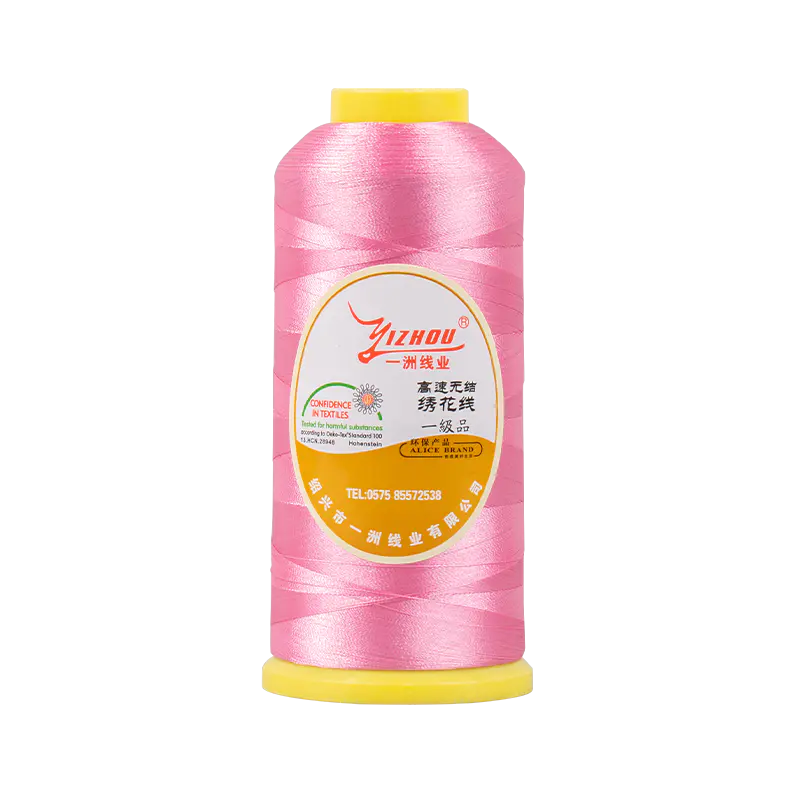 120D/2 Polyester Embroidery Thread for Versatile LaceA balanced, general-purpose thread for most machine lace, providing better coverage than finer weights while remaining fine enough for dense motifs and eyelet work. Engineered for high-speed commercial machines, it runs smoothly, reduces lint, and suits both needle and bobbin in many applications.View Product →
150D/2 for Bold and Dimensional Edges
150D/2 is the heavier tool for lace that needs presence. Use it for scalloped outer edges, corded-looking borders, appliqué edges on bridal gowns, and heirloom work where the edge stitch must be pronounced. It is also a practical choice when the lace will survive heavy use, such as lingerie trim or lace that is washed frequently. The cost is drape: 150D/2 makes a stiffer lace, so it is rarely the right choice for a full veil motif on fine tulle. When a design combines a large motif with an outer edge, many production shops stitch the body of the lace in 120D/2 and the outer edge in 150D/2 to get both openness and definition.
| Thread label | Approximate total denier | Typical needle size | Recommended lace use | Character of the finished lace |
|---|---|---|---|---|
| 75D/2 | 150 d | 75/11 | Bridal veils, fine tulle, fine freestanding lace | Light, airy, soft drape |
| 120D/2 | 240 d | 80/12 | General lace, eyelet, net appliqué, lettering | Balanced coverage and drape |
| 150D/2 | 300 d | 90/14 | Scalloped edges, borders, heavy lace, appliqué outlining | Dimensional, firm, pronounced edges |
If you have no existing factory sample to guide you, start with 120D/2 for the first lace trial. It will tell you quickly how the machine, stabilizer, and design interact. Then go finer or heavier only when the specific lace effect requires it. A useful production rule is to choose the thinnest thread that still gives the required edge definition and strength, because fineness preserves the open structure that separates lace from ordinary embroidery.
Needles, Tension, and Machine Settings for Polyester Lace
Thread is only half of the story. Polyester's elasticity and smoothness change the way a machine needs to be set, and lace's dense satin stitches amplify every setting error. Run the same polyester cone on the same machine with slightly different tension, and you can get brittle edges, loose bobbin loops, or tiny breaks that appear only after a hundred pieces are already stitched.
Needle selection comes first. For lace work on fine grounds, use a sharp-point needle sized to the thread: 75/11 for 75D/2 polyester, 80/12 for 120D/2, and 90/14 for 150D/2. A sharp point parts tulle and netting cleanly instead of forcing the ground yarns apart and distorting the holes. For knitted net grounds, a light ball-point needle is an alternative because it slips between the loops rather than piercing them; test both on a sample to see which gives cleaner holes for your specific fabric. When stitching dense lace at high speed, replace the needle regularly, at least every eight to ten hours of production. A burred or slightly bent needle damages continuous filament thread and causes skip stitches that ruin an open pattern.
Tension is where most lace problems begin. Polyester stretches more than rayon or cotton, so the upper tension needs to be stable and set slightly higher relative to the bobbin tension to produce a balanced stitch. Start from the machine manufacturer's baseline setting, then test on the same stabilizer that will be used in production. If the needle thread lies flat and the bobbin thread is barely visible on top of the lace, the tension is close to correct. If loops appear on the surface or the stitch feels raised, loosen the upper tension a quarter turn at a time. If the thread snaps during high-speed runs, the problem is often a combination of excessive tension and a needle that is too small for the thread, rather than a defect in the thread itself.
Bobbin thread deserves equal attention. In a closed lace pattern the bobbin thread is normally hidden, but in open lace areas it can appear on the surface if the tension drifts. Use a polyester bobbin thread from the same dye lot as the upper thread, or a neutral shade that disappears into the design. Many production shops use a slightly finer bobbin thread such as 75D/2 or a dedicated bobbin grade, which reduces bulk in the tightest stitch columns and helps the machine form a balanced stitch at high speed.
Needle heat deserves special attention in lace production. Fine needle sizes, dense stitch patterns, and synthetic ground fabrics generate friction that can heat the needle above the softening point of polyester, which is roughly 220°C. A needle that overheats can produce a burnished, weakened spot in the filament that breaks at the worst possible moment. Slowing the machine slightly for satin-stitch edges, keeping needles fresh, and using a thread lubricant designed for filament yarns will normally control this. Do not assume that a broken thread means bad thread; check the needle condition and temperature first.
Use a practical setup checklist before committing a lace order to production:
- Run a full test sample on the exact stabilizer and fabric combination before starting the commercial run.
- Check the dye lot of all cones so that every piece in the order matches, especially in open lace areas where the bobbin thread can show through.
- Set stitch density between 4 and 7 stitches per millimeter in open lace areas and between 6 and 8 stitches per millimeter on satin edges, adjusting for the chosen denier.
- Eliminate surface loops or tension artifacts on the test sample before touching the production design file.
- Keep a written record of tension settings, needle size, speed, and stabilizer type for each lace design so the setup can be repeated on future orders.
- Inspect the underside of the lace, because in freestanding work the bobbin side becomes the back of the finished lace and any unbalanced stitch shows immediately.
None of these steps is difficult by itself, but they are interconnected. A change in thread weight forces a change in needle, which changes the stitch formation. A change in stabilizer changes how much the needle deflects in dense areas. Approaching polyester lace work as a system, with thread, needle, tension, speed, and stabilizer all considered together, is what separates clean production from constant stopping and rethreading.
Working with Water-Soluble Stabilizer and Net Grounds
Freestanding lace is created by embroidering directly onto water-soluble film, often called dissolvable film or PVA film, and then dissolving the film away in warm water after stitching. The film supports the stitches while they are being placed, then disappears, leaving only the thread structure. In this process, the stabilizer is nearly as important as the thread itself.
Polyester is the easiest fiber to use with soluble film because the finishing bath does not attack it. Water at 40 to 60°C dissolves most PVA films quickly without harming a polyester filament. Rinsing until the film is completely gone, then drying the lace flat, produces a clean and stable result. Rayon thread, by contrast, can lose its shine and some of its dye in warm water, and its low wet strength increases the risk of breaking edges while the wet lace is being handled. This is one of the clearest practical arguments for polyester in lace production.
Schiffli lace production, also called chemical lace or burnt-out lace, adds another consideration. In this process, the embroidery is stitched on a ground fabric that is later dissolved or burned out, leaving the lace design. The thread must therefore withstand the removal chemistry, which is often hot and alkaline, without losing color or breaking down. Polyester's chemical resistance makes it well suited to this method, and the same continuous-filament construction that keeps needles clean in ordinary embroidery prevents the fraying that would appear in chemical lace when a spun cotton yarn is attacked by the removal bath. For Schiffli work, the denier choice is usually 120D/2 or 150D/2 because the lace tends to be more structured and needs stronger edges.
When embroidery is applied to tulle or net rather than to soluble film, the ground fabric is extremely open. Use a thin water-soluble topping film over the net to hold the net threads in place while the needle penetrates, and stitch at a slightly reduced speed so the needle does not deflect off the slippery ground. A fine 75D/2 or a medium 120D/2 thread usually gives the best result. Heavy threads and high tension distort the hexagonal openings of the net and destroy the lace illusion.
Scalloped and corded edges deserve their own attention. Lace trims usually finish with a satin stitch edge that is later cut or dissolved out. This edge stitch is dense, repeated many times over, and therefore highly sensitive to thread quality. A smooth trilobal polyester thread gives the edge a clean, continuous surface without the fuzzy halo that spun threads create. If the design calls for a cording effect, a second pass with a heavier thread or a slightly higher tension can produce dimension without changing the design file, although this must be tested before production because cording tends to pucker fine grounds.
After dissolving or trimming, press the lace on a low-temperature iron or use steam at a distance. Polyester softens at high heat, so a direct hot iron can flatten the lace into a shiny film and even melt the filament structure. A pressing cloth at a synthetic fabric setting is the safe routine for industrial production, and the same rule applies to all polyester lace work.
Care, Washing, and Color Retention in Finished Lace
Lace is rarely a permanent display object. It goes into clothing, curtains, lingerie, and trims that are washed, dried, bleached, and pressed. The thread choice determines whether that lace keeps its shape and color after the first few lifecycles, and this is where polyester's engineering advantages become visible to the end customer.
Polyester's low moisture regain is a structural advantage in care. Rayon absorbs water and swells, which changes the dimensions of a dense lace patch and weakens the yarn when wet. Cotton behaves in a similar way, although less dramatically. Polyester filaments absorb only small amounts of moisture, so wet washing does not soften, stretch, or distort the lace structure. That is why polyester lace holds its edges and motif registration wash after wash, while lace made with moisture-hungry fibers tends to go limp or shrink unevenly.
Colorfastness is the second major advantage. Dyes used on polyester are usually dispersed dyes applied at high temperature, and they are much more resistant to fading from sunlight and laundering than the direct and reactive dyes commonly used on rayon and cotton. White and pastel laces, which form the majority of the lace market, benefit most, because yellowing and dulling are the first defects a customer notices on an expensive garment.
When a lace supplier provides wash-fastness information, the standard tests are usually based on AATCC methods that measure color change after repeated laundering. For polyester thread with quality dispersed dyes, a rating of 4.0 to 5.0 on the gray scale for color change is common after five or ten washes, while poorly dyed thread can drop to 2.0 or 3.0 in the same test. For lightfastness, polyester is generally rated far above rayon, which means polyester lace holds its color in sunlight on hems, cuffs, and yokes that are exposed every day. These numbers give a quantifiable reason to choose polyester over rayon for lace that will be worn all day and washed every week.
If the finished lace will face extreme conditions, such as chlorine in swimwear, strong detergents in industrial laundry, heavy sun exposure in curtains, or very frequent washing in children's clothing, consider dope-dyed polyester. In dope-dyed thread, pigment is added to the polymer before the filament is extruded, rather than being applied to the finished yarn in a dye bath. The color runs through the entire filament, so fading, crocking, and bleeding are reduced to the minimum possible for any synthetic fiber. For lace that must never shift tone, dope-dyed polyester is the strongest option available.
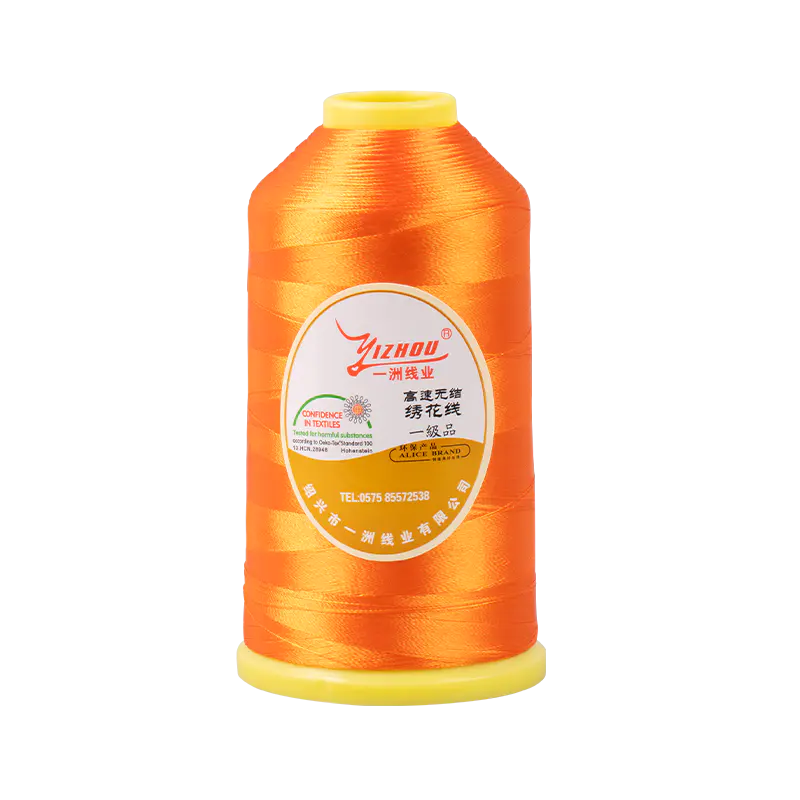 150D/2 Dope Dyed Polyester Embroidery ThreadPigment is embedded directly into the filament, producing exceptional color consistency and high fastness to washing and light. This solution-dyed thread is built for lace that must withstand harsh conditions like chlorine, industrial laundry, or sun exposure without fading or shifting tone.View Product →
For a more detailed view of wet-processing behavior, you can read how polyester embroidery thread performs in washing and dry cleaning. In short, polyester lace can generally be machine-washed at 40°C, dried flat or at a low dryer setting, and treated with oxygen-based bleach. Chlorine bleach affects conventionally dyed polyester less quickly than it affects natural fibers, but it is still safer to test a sample before processing a full batch. Ironing should always be done at a synthetic temperature with a pressing cloth.
The difference between dope-dyed thread, standard high-temperature dyed thread, and cheap unbranded polyester shows up exactly in this area of the production chain. If a supplier cannot provide a wash-fastness statement or a dye-lot reference for its cones, that is a warning sign. Color consistency across a lace run is a production requirement, not a cosmetic detail, because the open structure of lace makes even a half-shade difference between panels obvious.
What to Check When Buying Polyester Thread in Wholesale Quantities
For a production embroiderer, the thread is a raw material whose failures appear as machine downtime and rejected pieces. A single knot or slub in a cone of polyester thread can stop a multi-head line for a rethreading cycle that costs more in lost production than the cone itself costs. That is why wholesale buyers should evaluate the thread carefully before evaluating the price.
The first quality indicator is diameter consistency. Lace machines run the same thread through the same needle thousands of times, so any variation in denier or twist changes the stitch appearance. Reliable manufacturers control tension and temperature during filament spinning and twisting so that denier stays within a tight tolerance from the start of the cone to the end. Inconsistent thread is the most common hidden cause of uneven lace edges and unexplained thread breaks.
The second indicator is the twist itself. Balanced twist holds the two plies together without kinking, spins cleanly off the cone, and produces a uniform satin stitch. The twist must be stable enough that the thread does not untwist at the needle eye, yet soft enough that it does not corkscrew into loops. This balance is the kind of detail a manufacturer only achieves through consistent process control, which is why the production experience of the supplier matters more than a tempting price per cone.
The third indicator is the dye lot system. A single lace order may use dozens of cones. If the color varies between cones, the open structure of lace shows the difference immediately, especially on white and pastel shades. A professional polyester embroidery thread manufacturer keeps dye-lot records, supports match-to-sample requests, and can reproduce the same colors on reorders months later.
The fourth indicator is manufacturing scope and quality assurance. A supplier that controls production from yarn extrusion to the finished cone can guarantee consistency in a way that a trader or middleman cannot. Shaoxing Yizhou Thread has manufactured polyester embroidery threads since 1998, exporting to more than 30 countries with an annual production capacity above 5,000 tons. In practice, that scale means that every spool is wound under the same quality discipline, and a buyer can expect the same tension, twist, and dye behavior on a reorder placed long after the first shipment.
Beyond the cone itself, buyers should look at service capability. A manufacturer that handles both standard and dope-dyed polyester thread can give honest advice about which product suits a given lace application, because it controls both technologies. Customization, such as special package sizes, color development, and private labels, is more reliable when the factory owns the extrusion and twisting lines rather than buying greige yarn from another mill. These service factors become decisive when a lace collection is developed season after season and needs consistent thread with a stable supply chain.
These are the practical questions most professional buyers ask before committing to a large order:
- What is the exact total denier of the thread, and what is the tolerance range?
- What are the tenacity and elongation at break values?
- Which dye process is used, and can you provide wash-fastness and light-fastness test reports?
- How many yarn joins or defects are permitted per cone, and what is the maximum cone length?
- Can you supply matching color batches for a large production run?
- What is the twist direction and twist per meter of the thread?
- What packaging sizes are available, and what is the lead time for a repeat order?
Buying on these criteria instead of price alone is the difference between a lace line that runs smoothly and one that burns hours in re-threading. The three weights discussed earlier in this article, 75D/2, 120D/2, and 150D/2, correspond to the three most common lace production profiles, so a supplier that can answer these questions for all three is a much more reliable partner for a long-term lace program.
The Bottom Line for Lace Machine Embroidery
Can you use polyester thread for lace machine embroidery? Yes, and for most commercial lace production it is the most dependable answer available. It outperforms rayon in washing and wet strength, outperforms cotton in lint and durability, and adds a controlled luster that modern trilobal filaments can make just as elegant as natural silk.
Choose the weight based on the lace effect: 75D/2 for airy and fine laces, 120D/2 for balanced everyday lace work, and 150D/2 for bold and dimensional edges. Set the machine deliberately, with the correct sharp needle, stable tension, sensible speed, and a test sample on the same stabilizer, and lace production becomes repeatable rather than experimental.
For maximum color stability in demanding applications, dope-dyed polyester thread is the highest-performing choice. And for any volume purchase, verify the supplier's denier tolerance, twist balance, dye-lot discipline, and production history before loading a pallet of cones.
The lace pieces that survive production, washing, and years of wear are not made by magic. They are made by the right fiber, the right fineness, and the right quality control, all of which point back to a polyester thread that was engineered to be dependable.