
 中文简体
 English


Wanghe Industrial Park, Qixian Street, Keqiao District, Shaoxing City, Zhejiang Province, China.
The Short Answer: Yes, with the Right Setup
Polyester embroidery thread is not only for multi-needle embroidery machines. It can be used for regular sewing in a standard domestic machine, and for some projects it produces results that are just as good as, or better than, what you would get from an all-purpose sewing thread. The conditions matter more than the material itself: you need to choose a suitable thickness, use a needle matched to both the fabric and the thread, and adjust your upper tension around the fact that embroidery thread is smoother and less heavily twisted than most general-purpose sewing threads. When these variables are aligned, polyester embroidery thread will sew through woven cotton, linen, polyester blends, and many knits without breaking, puckering, or shedding lint.
The confusion is understandable. The word "embroidery" suggests a narrow purpose, and most retail packaging reinforces that idea with images of hoops and decorative stitches. In reality, polyester embroidery thread belongs to a broad family of spun polyester threads. It shares the fiber chemistry of standard polyester sewing thread, which means it has good tensile strength, low moisture absorption, and strong resistance to ultraviolet fading and repeated laundering. What differentiates embroidery thread is the way the yarn is assembled and finished, not the base polymer itself. That is why a carefully chosen embroidery thread can perform like a fine sewing thread in situations where appearance, color, and low bulk matter more than maximum seam abrasion resistance.
That said, "can be used" is not the same as "should always be used." For a plain seam in a pair of work trousers or a heavy canvas tote bag, you will get a more durable result from a purpose-built polyester or poly-cotton sewing thread. For visible stitching, appliqué, hems on lightweight garments, quilting details, and any project where the thread is meant to be seen, polyester embroidery thread is often the better choice precisely because it was engineered to show color and definition on the surface of the fabric.
This article explains the technical differences between embroidery thread and sewing thread, gives you a practical matching system for weight, needle, and tension, and tells you exactly where the substitution works and where it will waste your time.
What Polyester Embroidery Thread Is Made Of
Polyester embroidery thread starts as polyester polymer that is melted and extruded into continuous filaments, or cut into staple fibers and spun into yarn. Both routes produce a thread with the same useful properties: low water absorption, high dimensional stability, strong color retention, and very little lint. For embroidery, the manufacturer then twists two strands together to create a stable, round thread that can withstand the rapid stopping and starting of high-speed embroidery machine movement without untwisting or fraying.
The two-ply construction is important. A thread labeled 75D/2 consists of two plies, each of 75 denier, twisted together. The "/2" is not a decorative detail; it tells you that the final thread has roughly 150 denier of total linear density. In practical terms, 75D/2 is a fine, light thread that lies flat against delicate fabric. A 120D/2 thread uses two 120-denier plies for a total around 240 denier, which produces a medium-weight thread with good coverage. A 150D/2 thread combines two 150-denier plies for about 300 denier, making it the heaviest of the three common embroidery weights and the one with the most visible presence on the surface of the cloth.
The denier number is a linear density measurement: higher denier means a heavier, thicker yarn, while lower denier means a lighter, finer yarn. In the context of regular sewing, these numbers translate into how much bulk the thread adds to a stitch line, how much strength each stitch carries, and which needle sizes will work without deflecting or shredding the thread. You cannot simply judge embroidery thread by the diameter of the spool or the length of the cone; the denier specification is the reliable guide.
There is also a color-specific version worth understanding before you decide whether to use it for garment sewing. Dope-dyed polyester embroidery thread has pigment added to the polymer melt before the filament is extruded, so the color is locked into the structure of the fiber itself rather than applied as a surface dye afterwards. This makes the thread significantly more resistant to washing, dry cleaning, prolonged sun exposure, and rubbing. If you are sewing an item that will be laundered repeatedly, a dope-dyed polyester thread is one of the most color-stable threads you can put in a domestic machine.
How Embroidery Thread Differs from Standard Sewing Thread
Polyester embroidery thread and polyester all-purpose sewing thread come from the same fiber family, so the differences are in construction and finishing rather than chemistry. The table below summarizes the main technical distinctions that affect regular sewing behavior.
| Aspect | Polyester embroidery thread | Regular all-purpose sewing thread |
|---|---|---|
| Primary design goal | Appearance and stitch definition on the surface of fabric | Durable seam under stress |
| Twist level | Moderate to light twist for softness and sheen | Higher twist for abrasion resistance and strength retention |
| Finish | Soft, lustrous, lightly lubricated | Bonded or glazed finish, more resistant to friction |
| Typical plies | 2 | 2 or 3 |
| Lint production | Very low | Low for 100 percent polyester; higher for cotton or poly-cotton blends |
| Common weights | 75D/2, 120D/2, 150D/2 | Tex 21 to Tex 60, plus count-based systems |
| Best role | Visible stitching, appliqué, fine detail work | Structure, seams, buttonholes, topstitching on heavy fabric |
The twist angle is the first practical difference you will notice. Sewing thread is twisted more tightly because the repeated friction of passing through fabric, needle eye, and thread guides tends to untwist a loose yarn. If a thread untwists during sewing, it loses strength, starts to fray, and eventually breaks. Embroidery thread, by contrast, uses a lighter twist so that the surface of the thread reflects light more evenly and the stitch has a softer, more premium look. In a regular sewing machine running at a moderate speed, this lighter twist is usually not a problem. At very high speeds, or when sewing through dense and abrasive fabrics such as heavy denim or coated canvas, the lower twist can become a weak point.
The finish and lubrication are the second difference. Many all-purpose sewing threads receive a glazed or bonded finish that coats the surface, reducing friction and protecting the yarn from heat generated by the needle. Embroidery threads typically have a soft finish with just enough lubrication to run smoothly through an embroidery machine but not enough to survive the punishing conditions of heavy seam construction. For most domestic sewing, this distinction is not critical. For a bag strap that will carry a heavy load, or a pair of trousers that will be worn and washed weekly, the bonded finish of a true sewing thread gives a genuine durability advantage.
Tensile strength is where the two threads are easiest to confuse. A 120D/2 polyester embroidery thread can pull apart at a similar force to a 50-weight polyester sewing thread. The difference appears over time: a seam sewn with embroidery thread loses strength faster under repeated flexing, rubbing, and washing because the lower twist and softer finish allow individual fibers to break and pull apart. If you understand this, you can use embroidery thread confidently in the situations where it is genuinely appropriate, and reach for a proper sewing thread when the seam is the load-bearing element of the garment.
Where Polyester Embroidery Thread Works Well in Regular Sewing
Polyester embroidery thread performs best when the thread itself is part of the design, rather than when it is hidden inside a structural seam. In these applications, its sheen, color clarity, and smooth surface are advantages, and its slightly lower abrasion resistance rarely matters because the thread is not subjected to continuous load.
- Appliqué: embroidery thread is the standard choice for applying fabric shapes to a base garment. Its smooth surface prevents the thread from abrading the edge of the appliqué fabric, and the high sheen makes the satin stitch border look polished.
- Decorative topstitching on lightweight and medium-weight garments: a 120D/2 or 150D/2 embroidery thread creates a crisp, glossy stitch line on collars, pockets, plackets, and hems without the heavy ridge that a thicker topstitching thread would leave.
- Hemming fine fabrics: a 75D/2 embroidery thread is fine enough to disappear into chiffon, silk, lawn, and other delicate materials, while still providing a strong enough stitch for a hem that is not under heavy stress.
- Quilting and patchwork: quilters have used polyester embroidery thread for years, especially for quilting stitches that are meant to be visible. It glides through several layers of cotton without excessive drag and holds color through repeated washing.
- Visible mending: when you intentionally repair a tear or hole with a decorative stitch, the color range and sheen of embroidery thread help the repair become a design feature instead of an eyesore.
- Basting and fitting: a fine 75D/2 thread is easy to remove and does not leave visible marks when you pull it out, making it a good choice for temporary construction seams.
One particularly good match is sewing on knit fabrics with a stretch or ballpoint needle. Polyester embroidery thread has a useful amount of elasticity because the filaments are continuous and the twist is moderate. A straight stitch sewn with 120D/2 embroidery thread on a cotton-spandex knit, using a ballpoint needle and a slightly lengthened stitch, will stretch with the fabric better than a stiff cotton thread and will keep its color after many washes. The key is to avoid using embroidery thread in a tight, short, non-stretch seam on knit fabric, because that is where the seam itself will be stressed.
Another practical use is in the bobbin when you want a fine, low-bulk thread for shirring or gathering. A 75D/2 thread in the bobbin with a balanced tension produces a soft gather with very little thread bulk, which is useful for dressmaking details. Many home sewers find that a fine embroidery thread in the bobbin also solves tension problems when their bobbin case is stiff and needs a thin thread to feed smoothly.
Where It Falls Short: Seams, Stress Points, and Heavy Fabrics
Polyester embroidery thread has real limitations, and pretending otherwise will cost you time and fabric. The most important limitation is seam strength under load. A seam sewn with 120D/2 embroidery thread is not as strong as the same seam sewn with a 40-weight or 30-weight polyester sewing thread, simply because the embroidery thread is thinner and has less twist retention. For garments that get pulled, stretched, and worn against the body, that difference can mean the difference between a seam that lasts for years and one that opens after a season.
- Structural seams in trousers, skirts, and outerwear: use a dedicated polyester or poly-cotton sewing thread.
- Buttonholes: the repeated friction of a button moving through a buttonhole will break down a soft embroidery thread quickly. Sewing thread with a bonded finish is the right choice.
- Heavy fabrics: denim, canvas, upholstery-weight fabrics, and coated materials require a thread with higher abrasion resistance. A 150D/2 embroidery thread will sew into these fabrics, and the seam will look beautiful, but a proper topstitching or heavy-duty thread will hold up better after years of use.
- Overlock and serger seams: serger threads are engineered for the speed and tension of an overlock loop system. Embroidery thread, especially in a cone, can work temporarily, but it creates more friction in the loopers and is more expensive per meter than purpose-made serger cones.
- Upholstery and outdoor gear: seams here need maximum strength, UV resistance, and abrasion resistance. Polyester embroidery thread is UV-resistant but lacks the thick, bonded construction needed for load-bearing seams.
There is also a practical issue of cost. Polyester embroidery thread is sold on cones of 1,000 to 5,000 meters and is often priced higher per meter than all-purpose sewing thread because of the finer manufacturing tolerances and the wide color range. If you use it for an entire garment, including every internal seam, your thread cost will go up without giving you a corresponding benefit. Reserve embroidery thread for the places where it actually improves the final result.
None of this means that you cannot make a whole garment using embroidery thread. Plenty of home sewers have done exactly that, especially with lightweight blouses, children's clothing, and decorative linens. The garment will be fine as long as you are not expecting maximum seam strength. If you know that a particular seam will carry weight, such as the crotch seam of trousers or the handle of a bag, switch to a stronger thread for that seam and keep the embroidery thread for the visible stitches.
Matching Thread Weight to the Task
The single most useful step you can take when using polyester embroidery thread for regular sewing is to choose the correct denier. The three common weights, 75D/2, 120D/2, and 150D/2, cover different sewing roles, and they are not interchangeable. The table below gives a practical starting point.
| Thread weight | Approximate equivalent | Best suited for | Recommended needle | Example project |
|---|---|---|---|---|
| 75D/2 | Fine, roughly a 60-weight sewing thread | Lightweight wovens, fine knits, delicate details, basting, hems on silk and chiffon | 70/10 or 75/11 universal or sharp | Hem on a cotton lawn blouse |
| 120D/2 | Medium, roughly a 50-weight sewing thread | General garment sewing, appliqué, quilting, topstitching on medium-weight fabrics | 75/11 or 80/12 universal | Quilting seam on a linen top |
| 150D/2 | Heavier, roughly a 40-weight sewing thread | Decorative topstitching, heavier fabrics, visible mending, bag and outerwear details | 90/14 universal or denim needle | Topstitching on a canvas tote |
For fine fabrics, 75D/2 is the quiet hero. It is thin enough to sit inside the weave of a fine cotton or silk without disturbing the drape, yet strong enough for an ordinary straight stitch. If you have ever struggled with a visible hem line on a sheer blouse, switching to 75D/2 embroidery thread with a 70/10 needle will solve most of the problem. It also works well for hand-stitched hems, where a thicker thread would show as a ridge on the right side of the garment.
 75D/2 Polyester Embroidery Thread for Fine FabricsUltra-fine and strong, this 75D/2 polyester embroidery thread delivers precise, clean stitches on delicate materials like silk and organza, ideal for detailed lace and micro-lettering where a smooth, flat surface is essential.View Product →
The 120D/2 weight is the workhorse for regular sewing applications. If you want to test the idea of using embroidery thread for everything, start with 120D/2. It behaves much like a standard 50-weight polyester sewing thread, which means it works in most machines with minimal tension adjustment, and it has a sheen that makes seams look considered rather than accidental. Appliqué, patchwork, and visible stitching on medium-weight cotton or linen are all excellent choices for 120D/2.
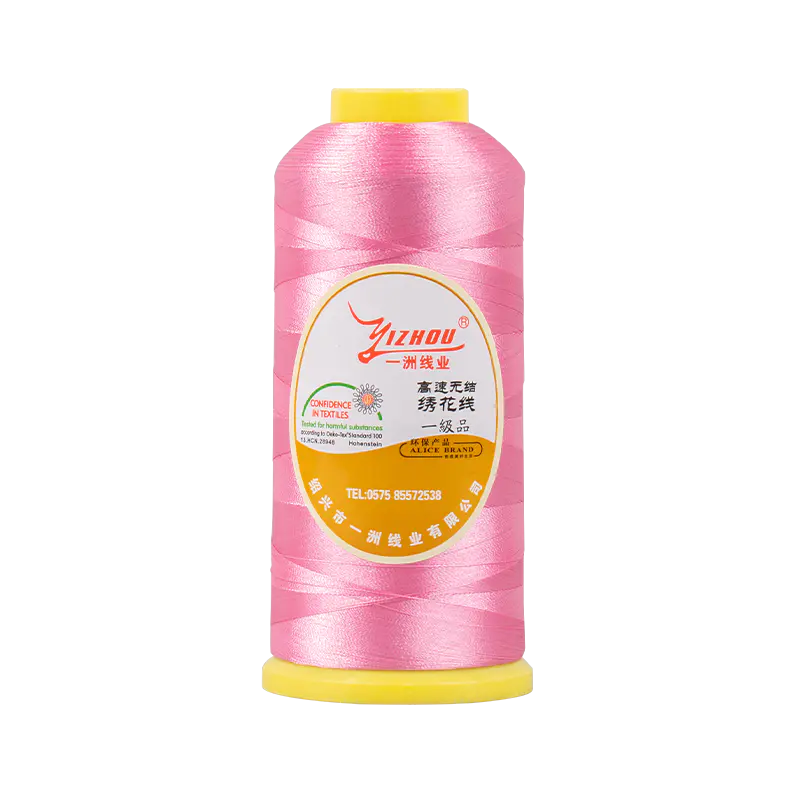 120D/2 Polyester Embroidery Thread for Everyday SewingThe industry-standard 120D/2 polyester embroidery thread balances strength and coverage, engineered for high-speed machines with reduced friction and lint. A dependable choice for appliqué, patchwork, and visible stitching on medium-weight fabrics.View Product →
The 150D/2 weight is for projects where the thread should act as a design element. It produces a wider, more visible stitch line, which is why it is often chosen for topstitching on bags, jackets, and home textiles. On a medium-weight fabric, 150D/2 can create a slightly raised effect that mimics a real topstitching thread, while still being smooth enough to pass through the needle eye without shredding. For heavy fabrics such as denim, use it with a 90/14 or 100/16 needle and test the tension before committing to a long seam.
If you are not sure which weight to buy, the safest approach is to start with 120D/2 and then move finer or heavier based on the fabric you actually sew most often. Choosing between the three weights comes down to the fabric and the kind of stitch you want to create. If you want to understand how the numbers translate into stitch behavior, this explanation of thread weight numbers covers the relationship between denier, ply, and sewing performance in more detail.
Needle Selection: The Missing Variable
Many sewers who try embroidery thread in a regular machine, and then abandon the idea, are using the wrong needle. The needle controls whether the thread reaches the fabric undamaged, how evenly it forms a stitch, and whether the machine skips stitches at speed. With embroidery thread, the needle choice is more important than the thread choice because the thread is smoother and has less tolerance for a damaged or poorly matched needle.
| Fabric type | Needle type | Needle size | Compatible embroidery thread |
|---|---|---|---|
| Silk, chiffon, lawn, fine cotton | Universal or sharp | 65/9 to 70/10 | 75D/2 |
| Quilting cotton, linen, poplin, blends | Universal | 75/11 to 80/12 | 120D/2 |
| Denim, canvas, twill, heavy linen | Denim or sharp | 90/14 to 100/16 | 150D/2 |
| Jersey, interlock, stretch knits | Ballpoint or stretch | 75/11 to 90/14 | 120D/2 |
A 75D/2 thread running through a 90/14 needle will flap around inside the needle eye, creating uneven tension and increasing the chance of skipped stitches. Conversely, a 150D/2 thread through a 70/10 needle can jam, fray, or break because the eye is too small for the total diameter of the two plies. The general rule is to match the needle eye and groove to the thread: fine thread needs a fine needle, heavy thread needs a heavier needle. This is the same rule you would follow with sewing thread, but it matters more with embroidery thread because the finish is softer and the thread cannot tolerate being forced through a needle that is too small.
For wovens, use a universal needle or a sharp needle depending on how crisp you want the stitch. A sharp needle creates a cleaner hole and better stitch definition, which is useful for topstitching. For knits, a ballpoint needle pushes the yarns apart instead of cutting them, which prevents skipped stitches and laddering along the seam line. If you are sewing a stretch fabric with embroidery thread and you get skipped stitches, the first thing to change is the needle, not the tension.
Before you start a project, check the needle for burrs. Run your fingernail over the point and the eye; any snag will damage a soft embroidery thread long before a regular sewing thread would show a problem. Replace the needle routinely every six to eight hours of actual sewing, and every hour when sewing through abrasive fabrics like denim or canvas. A fresh needle is the cheapest way to guarantee that your embroidery thread performs well in a regular machine.
Tension, Stitch Length, and Machine Settings
The most common complaint after switching to embroidery thread is looping. Usually this is a tension issue, not a thread defect. A balanced stitch is created when the needle thread and bobbin thread meet in the middle of the fabric layers. If the bobbin thread is heavier than the needle thread, or the needle thread is too loose, the bobbin thread will pull to the top and create loops. If the needle thread is too tight, it will pull the bobbin thread up, causing puckering or a visible ridge.
Start with the upper tension set to a middle value, usually between three and four on a domestic machine. Sew a test line on a scrap of the actual fabric you plan to use, using the actual needle and thread combination. Look at both sides of the seam. If you see small loops on the underside, the upper tension is too loose and you should increase it by half a unit at a time. If you see loops on the top side, the upper tension is too tight, or the bobbin tension is too loose, and you should reduce the upper tension first. If the thread breaks, you are either running the tension too high for the thread weight, or the needle eye is too small.
Stitch length also needs adjustment when you switch to embroidery thread. The standard 2.5 mm setting works well for 120D/2 on medium-weight fabric, but fine 75D/2 thread on lightweight fabric gives better results with a slightly shorter stitch of 2.0 to 2.2 mm, which prevents the seam from showing a dotted line on the right side. For visible topstitching with 150D/2, increase the stitch length to 3.0 mm or even 3.5 mm so that the heavy thread lies smoothly instead of stacking up and creating a ridge.
The bobbin is the part most people forget. Winding the bobbin with the same embroidery thread you are using in the needle gives you the most consistent tension, but it also uses a lot of thread on a project with long seams. A practical alternative is to wind the bobbin with a fine 75D/2 embroidery thread, or with a lightweight 50-weight polyester sewing thread, and keep the heavier 120D/2 or 150D/2 on top. When you change only the needle thread and leave a heavier bobbin thread installed, you will fight looping and puckering for the entire project. If your machine has a drop-in bobbin case with a tension dial, check that the thread slides under the tension spring smoothly; a rough spring can abrade a soft embroidery thread.
Testing the Thread Before You Sew the Real Project
A five-minute test saves hours of seam ripping. Embroidery thread behaves slightly differently from sewing thread in every machine, and the only reliable way to know how your machine, needle, fabric, and thread will work together is to sew a sample. The test does not need to be fancy, but it needs to include the same materials and settings you will use for the real garment.
- Cut a square of the actual fabric you will sew, including interfacing or lining if you are using any.
- Thread the machine with the embroidery thread you plan to use and wind the bobbin with the bobbin thread you plan to use.
- Sew a straight seam about 15 cm long at a medium speed, using the stitch length you intend to use.
- Inspect both sides of the seam: the top side should show crisp, slightly shiny stitches, and the underside should show evenly formed loops that do not pull through to the top.
- Tug the seam from both sides with firm force. You should feel the fabric stretch before the thread breaks. If the thread snaps during the tug test, the seam will not survive everyday wear.
- Wash and dry the sample the way you will launder the finished garment, including detergent. Check for color transfer, thread breakage, puckering, or a change in sheen.
- Sew a second seam after washing to see if the thread in the machine still behaves the same way; some threads swell or soften after humidity exposure, although polyester is generally stable.
The wash test is especially important if you sew garments for children or items that will be laundered frequently. A thread can look perfect when it comes out of the machine and still weaken noticeably after a few washes. With polyester embroidery thread, the usual result is excellent: the color stays, the sheen dulls slightly but evenly, and the seam holds. If your test sample comes out of the wash with a broken stitch or a loose seam, you now know to use a stronger thread for structural seams and limit the embroidery thread to decorative areas.
Washability, Colorfastness, and Long-Term Appearance
One of the main reasons to choose polyester embroidery thread over rayon or cotton thread for regular sewing is how it behaves in the laundry. Polyester is hydrophobic, which means it does not absorb water the way cotton does. It does not shrink, it dries quickly, and it does not lose strength when wet. A garment sewn entirely with polyester embroidery thread will survive repeated machine washing without the thread swelling, shrinking, or breaking inside the seam allowances.
Colorfastness is another strength of the polyester fiber. Standard dyeing processes used for polyester embroidery thread, when carried out at high temperature, penetrate the polymer structure and resist washing out. In normal home laundering, you will not see color bleed from a polyester embroidery thread onto white fabric, even in warm water. The thread is also resistant to ultraviolet light, which makes it a good choice for garments and accessories that will spend time outdoors. Compare this with rayon embroidery thread, which fades and weakens noticeably after exposure to sun and washing, and the practical advantage of polyester becomes obvious.
For maximum wash fastness, consider a dope-dyed polyester threading. The pigment is mixed into the polymer before the fiber is formed, so the color is an inseparable part of the filament rather than a coating. Dope-dyed thread is the preferred option for items that face harsh washing conditions, such as work uniforms, children's clothing, and outdoor textiles. It also produces less color variation between dye lots, which matters when you need to reorder thread for a production run or finish a large project months later. For a home sewer, the practical benefit is simple: the thread keeps its color after many more washes than a surface-dyed equivalent.
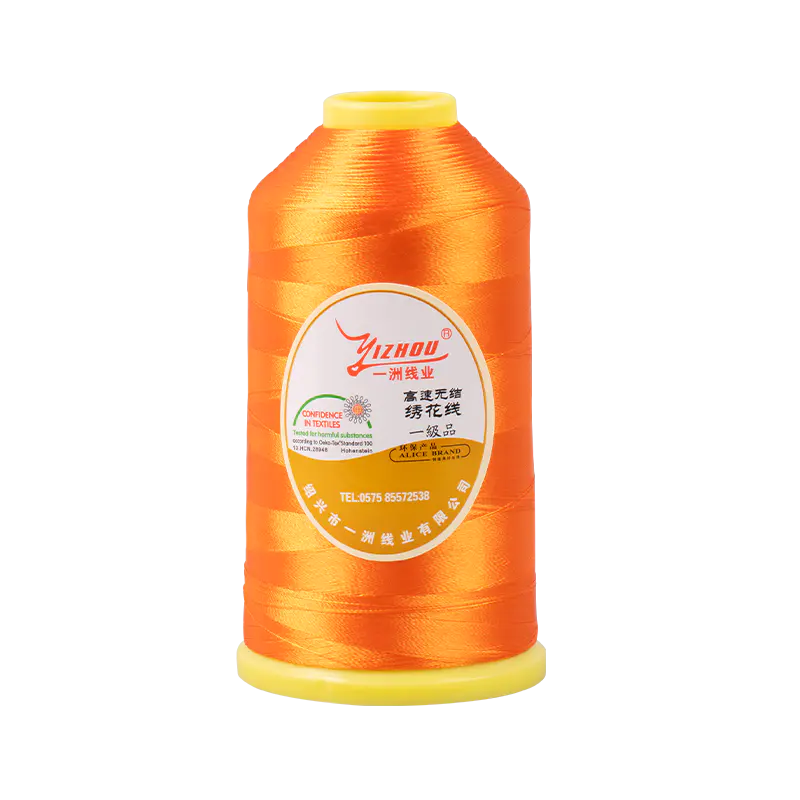 150D/2 Dope Dyed Polyester Embroidery Thread for ColorfastnessDope-dyed construction embeds pigment within the fiber, delivering exceptional color consistency and lasting vibrancy. This 150D/2 thread resists washing, light, and wear, making it ideal for premium apparel, uniforms, and decorative projects demanding durable visual appeal.View Product →
Dry cleaning is also effective with polyester embroidery thread. The thread does not absorb dry cleaning solvents, so it does not change color or lose elasticity. If you sew garments that are labeled dry-clean only, you can use polyester embroidery thread for both seams and decorative stitching without worrying about the trimming. Chlorine bleach, however, is worth avoiding: polyester is not dissolved by dilute chlorine bleach the way cotton is, but prolonged exposure will slowly weaken any polyester fiber and can yellow white thread. If you need to bleach a white garment, wash it first to confirm that the embroidery thread remains stable, and use oxygen bleach instead of chlorine where possible.
Common Problems and What to Do About Them
When you switch from sewing thread to embroidery thread, the problems that appear are almost always related to needle, tension, or thread path. The table below lists the issues you are most likely to meet and the practical fix for each one.
| Problem | Likely cause | Practical fix |
|---|---|---|
| Skipped stitches | Dull or damaged needle; needle too small; wrong needle type | Replace the needle; use the size that matches the thread; use a ballpoint needle for knits |
| Thread breaks during sewing | Upper tension too high; needle eye too small; burr on needle or needle plate | Reduce tension; increase needle size; inspect and replace damaged parts |
| Puckering along the seam | Tension too high; stitch too short; fabric too light for the thread weight | Lower upper tension; lengthen the stitch; switch to 75D/2 for fine fabric |
| Loops on the underside | Upper tension too loose; thread not seated in the take-up lever | Increase upper tension; rethread the machine carefully |
| Loops on the top side | Bobbin tension too loose; wrong bobbin thread | Adjust bobbin tension; wind the bobbin with the same light thread |
| Thread frays at the needle eye | Needle eye too small; rough needle; thread path obstruction | Use a larger needle; replace the needle; check the thread guides for nicks |
| Needle heating at high speed | Heavy thread, dense fabric, and high speed combined | Slow down; use a heavier needle; consider a thread lubricant for industrial machines |
The most common root cause behind several of these problems is a mismatch between thread weight and needle size. A 150D/2 thread through a 75/11 needle will struggle even if the tension is perfect. The thread needs enough room in the needle eye and groove to pass through without friction. When in doubt, move up one needle size and reduce the upper tension by half a setting. This combination solves more problems than any other single adjustment.
Thread path problems are also easy to overlook. Embroidery thread is softer than sewing thread and can slip out of a tension disc if the machine is threaded while the presser foot is down, or if the thread is not fully seated under the tension spring. Always thread the machine with the presser foot raised, and gently pull the thread through the tension and take-up lever before you start sewing. A clean and correct thread path eliminates a large share of looping and tension issues.
Lint is rarely a problem with polyester embroidery thread, but it can still appear if you are sewing over a dusty fabric or if the bobbin case accumulates loose fibers over time. Clean the bobbin area and the feed dogs after every project. A layer of lint can make the bobbin tension inconsistent, which creates loops and uneven stitching that look like a tension problem but are actually a cleanliness problem.
Cost and How to Buy for Regular Sewing
Cost shapes the decision to use embroidery thread for regular sewing more than most sewers expect. At retail, a 1,000-meter cone of polyester embroidery thread costs several times more than the same length of all-purpose sewing thread on a small spool. For a single garment, the difference is small enough to ignore. For a production run of fifty garments, the difference becomes significant, and you need to decide where the extra expense delivers a visible benefit.
Embroidery thread is sold on long cones because embroidery machines consume thread quickly. The same packaging works well for a home sewer: a 5,000-meter cone of 120D/2 thread will last through many projects, and the cost per meter drops substantially compared to small retail spools. The practical disadvantage of a large cone is that it does not fit on a domestic machine's vertical spool pin without an adapter, and the thread may feed unevenly from the cone base. You can solve this by using a cone thread stand, or by winding the thread onto a small empty spool with a manual winder. Neither option is difficult, and both make the economic case much stronger.
If you are buying for a small workshop or for ongoing sewing, buying direct from a manufacturer is worth considering. A thread manufacturer can supply consistent dye lots, which matters when a garment is cut and sewn over several weeks. They can also provide technical specifications such as tensile strength, elongation, and colorfastness ratings, which help you make a real engineering decision instead of guessing. When you order a thread weight that is new to you, request a sample cone, sew your test sample, and wash it before you place a larger order. The test protocol described earlier is exactly what a professional workshop would do before accepting a new thread into production.
Storage also protects your investment. Polyester thread does not rot or weaken with age the way cotton thread does, but it can absorb dust and take on creases if it is stored loosely. Keep cones in a plastic bag or a closed box, away from direct sunlight, and avoid leaving a cone on a machine for months between projects. Thread that has been exposed to heat and light in a sunny sewing room will have a slightly duller sheen, which is noticeable when you use it in a visible topstitch.
Final Recommendations for Home Sewers and Small Workshops
Polyester embroidery thread is a legitimate option for regular sewing, provided you treat it as a specialized tool rather than a universal substitute. Use it where the thread is visible and where its color, sheen, and smoothness improve the finished piece. Keep a standard polyester sewing thread on hand for the seams that hold the garment together, and do not feel guilty about mixing the two types in a single project. Professionals do this all the time: a fine 120D/2 embroidery thread for the visible topstitching, and a sturdy 40-weight polyester sewing thread for the structural seams.
The decision process is simple. Ask yourself two questions before you thread the needle. First, will this seam or stitch be visible in the final garment? If yes, embroidery thread is worth considering. Second, will this seam carry weight or withstand heavy use? If yes, a sewing thread will serve you better. When both answers are yes, such as with a front pocket seam on a linen apron, you can sew the structural part with sewing thread and switch to embroidery thread for the final visible pass.
Once you have made the choice, the installation routine is always the same: match the thread weight to the fabric, choose a needle sized for both, set the tension to a middle value, and sew a sample that you wash before committing. That routine takes ten minutes and turns "can I use this thread" into "this thread works." With a little practice, you will reach naturally for that 120D/2 cone as often as you reach for your all-purpose spool, and the seam quality of your everyday sewing will be better for it.