
 中文简体
 English


Wanghe Industrial Park, Qixian Street, Keqiao District, Shaoxing City, Zhejiang Province, China.
A production manager sends a purchase order for "40 wt polyester embroidery thread, 5,000-meter cones, 36 colors." The supplier quotes 120D/2. Both descriptions are correct, and that is exactly where the confusion begins. 40 wt names a weight class. 120D/2 names a linear mass and a ply construction. Polyester names the polymer. Change any one of the three and you are buying a different thread, even if the label still says 40.
The short answer: 40 wt is the general-purpose medium weight in machine embroidery, commonly supplied in polyester as 120D/2, and it covers most logo, cap, polo, bag, and flat-goods work. It is a poor choice for 3 mm lettering, and an equally poor choice for a heavy outline on denim. The rest of this guide explains why, and how to specify it so the thread that arrives matches the thread you tested.
What 40 wt Actually Measures
Thread weight is a length-per-mass number, not a diameter. In the retail convention used for embroidery thread, a higher number means a finer thread: 60 wt is thinner than 40 wt, and 40 wt is thinner than 30 wt. The number tells you how much length you get per unit of weight, which is useful for estimating coverage and cone yield, but it says nothing about fiber, tenacity, luster, or how many plies are twisted together.
That is why two cones labelled 40 wt can behave differently on the same machine. A 40 wt cotton, a 40 wt rayon, and a 40 wt trilobal polyester may share a weight class and still differ in tensile strength, elongation, friction, and color performance. Weight sets the visual scale of the stitch. Fiber and construction set how the thread survives the needle.
For planning, treat 40 wt as the middle of the working range. It gives enough coverage for a 40 mm to 60 mm logo without building excessive height, and it still turns tight curves on a 75/11 needle. Below that, 60 wt takes over for fine detail. Above it, 30 wt takes over for bold coverage.
| Thread weight | Typical polyester construction | Detail level | Common use |
|---|---|---|---|
| 60 wt | 75D/2 | Fine | Small lettering, dense logos, lightweight fabrics, quilting |
| 40 wt | 120D/2 | Medium | Caps, polos, flat goods, bags, general logo work |
| 30 wt | 150D/2 | Bold | Outlines, heavy fabrics, large fills, decorative coverage |
Why 40 wt Usually Lands Near 120D/2
Denier is a direct linear-mass unit: the weight in grams of 9,000 meters of yarn. A 120D/2 polyester thread is made from two 120-denier plies twisted together, so the finished thread carries roughly 240 denier of material. That sounds heavier than 40 wt, and in a strict formula it can be. In the polyester machine-embroidery trade, however, 40 wt is commonly stocked as 120D/2, 60 wt as 75D/2, and 30 wt as 150D/2. The mapping is a market convention that has settled around the coverage and machine performance buyers expect at each weight.
This is why the denier line on a spec sheet matters more than the weight line alone. A supplier can deliver a thread that weighs out at 40 wt but uses a different ply, a different filament cross-section, or a different fiber. The stitch may look acceptable in a sample and fail in production: more breaks at 900 stitches per minute, more puckering on stretch fabric, or a shade that shifts after three industrial washes. If you want the technical background on how these constructions differ, this explanation of what 75D/2, 120D/2, and 150D/2 mean in polyester embroidery thread is a useful reference for reading supplier data sheets.
For most buyers, the practical rule is simple: ask for 40 wt polyester with a stated denier and ply, then test that exact construction. Do not approve a bulk order from a weight description alone.
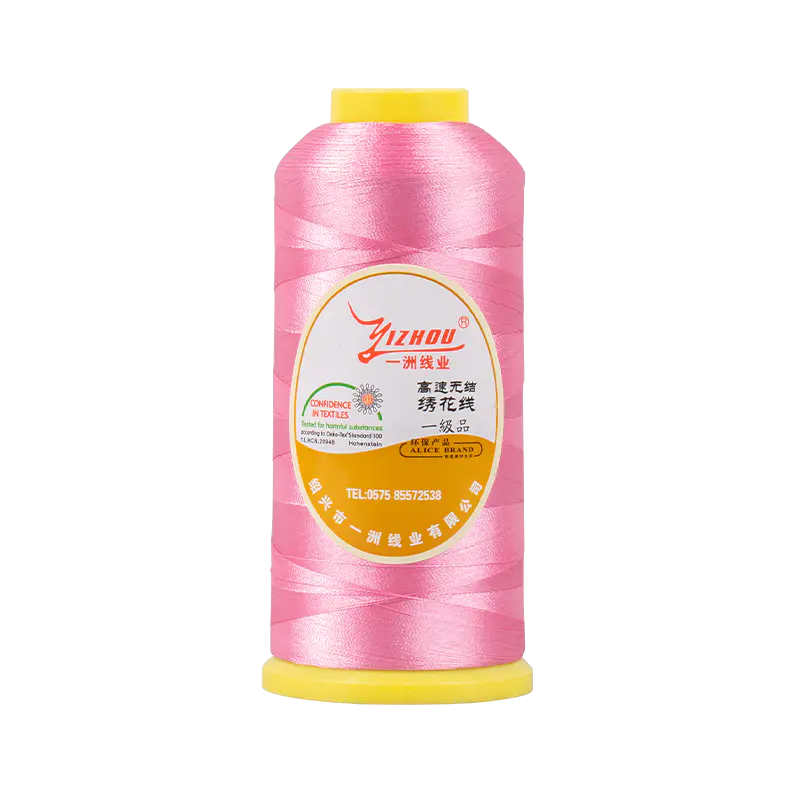 120D/2 Polyester Embroidery Thread for Commercial MachinesWidely used two-ply 120D/2 polyester thread balances strength and coverage for high-speed commercial embroidery; specify denier and ply, then test the exact construction.View Product →
Where 40 wt Earns Its Place on the Machine
On a commercial multi-head machine, 40 wt is the default for flat embroidery on woven shirting, twill, canvas bags, and corporate polos. It also handles caps well when the needle and backing are matched to the construction. A common starting point is a 75/11 sharp needle for caps and dense twill, and an 80/12 for general flats and knits. The smaller needle reduces flagging and needle marks; the larger needle reduces friction and breakage on heavier goods.
Stitch density needs to follow the fabric, not the thread alone. On stable woven cotton or polyester, a 0.40 mm column spacing is a reasonable starting point for 40 wt fills. On stretch knits, drop to 0.35 mm or add underlay and a cut-away backing; on pile fabrics such as towels, increase density and use a water-soluble topping to keep the stitches from sinking. Running 40 wt at 1,000 stitches per minute on a flat goods job is realistic on a well-maintained machine. On caps, 600 to 750 stitches per minute is often more productive once breakage and re-starts are counted.
Bobbin selection matters as much as the top thread. A 60 wt polyester bobbin with a 40 wt top thread gives a balanced stitch without excessive tension. If the bobbin is too heavy, the top thread is pulled down and the design looks thin; if the bobbin tension is too loose, the thread loops and the machine stops. Check tension on the actual fabric before the run, not on a scrap of the same color.
When 40 wt Is the Wrong Thread
The most common failure is using 40 wt for text that is too small. At 3 mm cap height, 40 wt fills in the counter of an "e" or the gap in an "a." The fix is not a slower speed or a different digitizer; it is a finer thread. A 60 wt polyester, typically 75D/2, gives cleaner small lettering and reduces the stitch count needed to cover the same area.
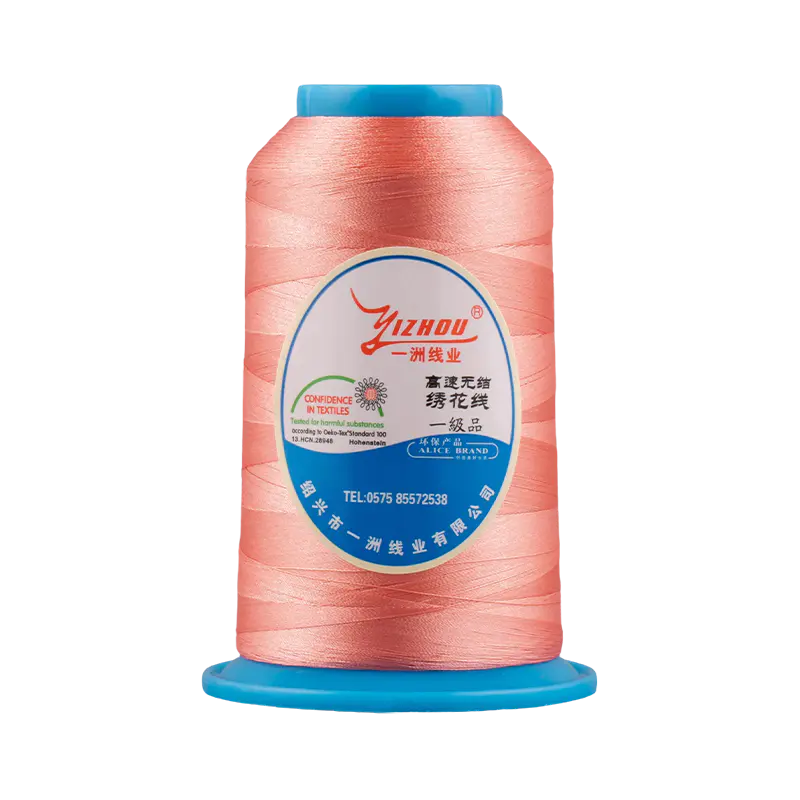 75D/2 Fine Polyester Embroidery Thread for Detail WorkFine two-ply 75-denier thread supports clean small lettering and dense detail, reducing bulk in intricate designs while maintaining strength and washability.View Product →
The second failure is under-building a heavy design. A 20 mm outline on denim or a large fill on a jacket back looks thin and flat in 40 wt, and the machine may need two passes to reach the required coverage. A 30 wt, typically 150D/2, builds height faster and produces a bolder edge with fewer stitches. The trade-off is that 30 wt is less forgiving on tight curves and small details, so it belongs on larger elements.
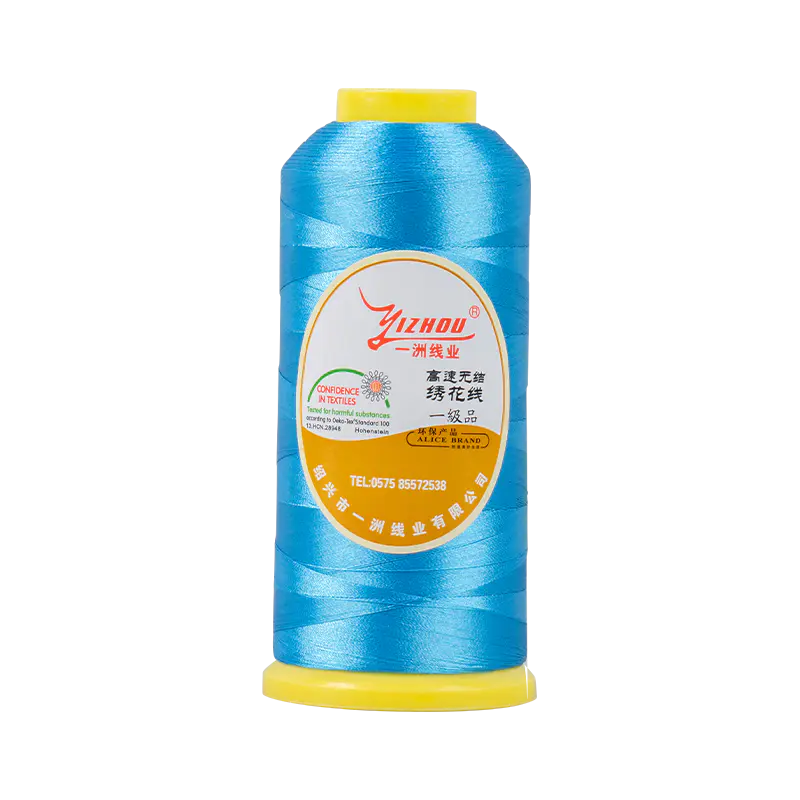 150D/2 Heavy Polyester Embroidery Thread for Bold CoverageHeavy two-ply 150-denier thread builds large fills and bold edges quickly, with abrasion resistance for denim, canvas, caps, and heavy-duty embroidered goods.View Product →
There is a third case that is less about weight and more about color durability: work that will be chlorine-washed, stone-washed, or exposed to industrial laundering. In that case, a dope-dyed polyester is worth considering, because the color is built into the filament rather than applied in a later dye bath. The dope-dyed polyester embroidery thread route is usually specified when shade retention matters more than the lowest thread price.
Fiber Changes the Answer More Than Weight Does
At the same 40 wt, polyester is the strongest general-purpose choice for high-speed machine embroidery. It has good abrasion resistance, low moisture regain, and strong colorfastness in the wash. Rayon at 40 wt is softer and produces a high sheen that many retail brands prefer for flat logos, but it loses strength when wet and is less durable under abrasion. Cotton at 40 wt is matte, handles heat well, and suits quilting and heirloom work, but it is weaker than polyester and can shrink or fade depending on the dye process.
The fiber decision should follow the end-use, not the machine. A workwear logo that will be washed at 60°C and tumbled dry belongs in polyester. A fashion logo on a lightweight blouse may look better in rayon. A quilt that will be pressed with steam belongs in cotton. Once the fiber is fixed, the weight sets the detail level, and the denier sets the construction.
What to Put on the Purchase Order
A weight and a color number are not a specification. The following details prevent most receiving disputes and production surprises:
- Fiber and polymer: 100% polyester, filament, with the filament cross-section stated if luster matters.
- Weight and construction: 40 wt, with the denier and ply written as a separate line, for example 120D/2.
- Tenacity and elongation: ask for the supplier's typical values and the test method used. Polyester embroidery threads commonly fall in a tenacity range of roughly 4.5 to 6.0 g/denier, with elongation around 20% to 30%, but the exact figure depends on the producer.
- Colorfastness: state the wash test, the temperature, and the acceptable shade change. For workwear, a test to AATCC 61 3A or the equivalent ISO method is more useful than a generic "colorfast" claim.
- Piecing and knots: specify the maximum number of knots or joins per cone. A low-cost cone with five knots can cost more in downtime than it saves in thread price.
- Cone yield and tube type: meters per cone, cone weight, and the tube dimension that fits your creel.
- Compliance: Oeko-Tex Standard 100 class, REACH SVHC status, AZO-free declaration, and any customer-specific restricted substance list.
- Lot consistency: ask for a single dye lot per color where possible, and state the acceptable Delta E between cones in the same lot.
Cost per 1,000 Stitches, Not Cost per Cone
Thread price is easy to compare and easy to misread. A 5,000-meter cone at a lower price per meter looks attractive until the break rate rises. On a 12-head machine running at 850 stitches per minute, a single thread break can cost two to four minutes of production across all heads, plus the operator's time to re-thread and restart. If a cheaper 40 wt adds one break per 10,000 stitches, the downtime can exceed the saving on the entire cone.
Build a simple consumption estimate instead. Measure the top-thread use for a typical 1,000-stitch logo on your own machine; most shops see roughly 4 to 8 meters per 1,000 stitches depending on density, underlay, and stitch length. Divide the cone price by the actual meters on the cone, multiply by consumption, then add 5% to 10% for waste, color changes, and trimming. Add the cost of one avoided break per 100,000 stitches as a quality credit. That number is the one to compare between suppliers.
A Three-Cone Trial That Settles the Argument
Before a bulk order, run a trial that reflects your real work rather than a single test square. A practical sequence:
- Select three fabrics you actually embroider: a stable woven, a stretch knit, and a cap or heavy canvas.
- Use two needle sizes, for example 75/11 and 80/12, and two speeds, one at normal production speed and one 15% faster.
- Run a design with small text, a curved outline, and a fill block. Record breaks, thread fuzz, puckering, and needle deflection.
- Wash one sample three times at the temperature your customer specifies, then compare shade, shrinkage, and stitch integrity against the unwashed control.
- Set acceptance criteria in advance: for example, no more than one break per 100,000 stitches, no visible shade shift within a lot, and no more than 2% shrinkage after three washes.
The trial should use the exact denier and ply you intend to buy, not a "similar" 40 wt from another source. If the supplier cannot state the construction, the trial cannot be repeated, and the approval has no value.
A Default, Not a Rule
40 wt earns its default status because it balances coverage, detail, and machine performance across a wide range of goods. It is not universal. Small lettering needs 60 wt, heavy coverage needs 30 wt, and harsh laundering may call for a dope-dyed construction. The useful discipline is to specify weight, denier, ply, fiber, and performance together, then test that combination on the fabrics and machines you actually run. That approach costs a few cones and a few hours, and it prevents the far more expensive discovery that the bulk delivery is not the thread you approved.