
 中文简体
 English


Wanghe Industrial Park, Qixian Street, Keqiao District, Shaoxing City, Zhejiang Province, China.
A production manager running twelve-head machines does not need the same thread as a hand embroiderer working a linen sampler. That sounds obvious, but it is the reason so many “best embroidery thread” answers fail. A thread that runs beautifully at 900 stitches per minute on a polyester polo shirt can fray, loop, or look flat in a hand-stitched floral design. A soft cotton floss that separates cleanly for hand work can snap under the heat and tension of a commercial embroidery head.
The short answer is this: for most machine embroidery on garments, caps, and promotional textiles, a 40-weight polyester thread is the best default. For hand embroidery, six-strand cotton floss is the best starting point. For fine detail, move to a 60-weight polyester or a 75D/2 polyester embroidery thread. For heavy coverage on denim, canvas, or thick fleece, a 30-weight polyester or a 150D/2 thread gives better coverage with fewer stitches. For color-critical industrial programs, solution-dyed polyester is often the safer production choice. The rest of this guide explains why those defaults work, where they fail, and how to specify thread without guessing.
Quick Answer by Use Case
Thread selection is a matching problem. You are matching fiber, weight, ply, lubricity, colorfastness, and needle size to a substrate and a stitching method. The table below gives a practical starting point. It is not a substitute for a stitch-out, but it prevents the most common wrong turns.
| Use case | Best starting point | Why it works | Watch-outs |
|---|---|---|---|
| High-speed machine embroidery on cotton, polyester, and blends | 40-weight polyester, often a 120D/2 construction | High tenacity, good abrasion resistance, and predictable running behavior at 700–1,000 stitches per minute | Excess tension causes needle deflection and thread breaks; verify colorfastness for wash-heavy programs |
| Fine lettering, small logos, and dense detail | 60-weight polyester or 75D/2 polyester | Lower bulk, sharper detail, and less buildup in small satin columns | Use a smaller needle and slow the machine slightly; fine thread can strip or loop if tension is too low |
| Heavy outlines, denim, canvas, and thick fleece | 30-weight polyester or 150D/2 polyester | Better coverage per stitch, fewer passes, and stronger outline definition | Needle size must increase; dense designs can become stiff or cause puckering |
| Hand embroidery on linen, cotton, and evenweave | Six-strand cotton floss | Soft hand, easy separation, and a matte finish that suits traditional surface embroidery | Keep working lengths short; long lengths abrade and pill |
| Heirloom, silk shading, and high-sheen decorative work | Filament silk or high-quality rayon | Lustrous appearance and smooth coverage on delicate fabrics | Higher cost, lower abrasion resistance, and sensitivity to rough needles or dry skin |
| Wool applique, crewel work, and textured hand pieces | Crewel wool | Warm, fuzzy texture and good coverage on heavy fabrics | Not ideal for wash-heavy items; felting and pilling are possible |
If you remember one rule from this table, make it this: polyester is the safest default for machine embroidery, and cotton floss is the safest default for hand embroidery. Everything else is a deliberate trade-off. Silk buys sheen at the cost of durability. Rayon buys luster at the cost of abrasion resistance. Wool buys texture at the cost of wash performance. Metallic thread buys visual impact at the cost of speed and tension tolerance.
Why There Is No Single Best Embroidery Thread
Embroidery thread is not judged on appearance alone. It is judged on how it behaves before, during, and after stitching. Before stitching, the thread must wind, feed, and unwind without tangling. During stitching, it must survive tension, needle heat, abrasion, and repeated flexing. After stitching, it must hold color, resist pilling, and survive the care routine the finished product will face. Those demands pull in different directions.
Fiber determines the floor and ceiling
Polyester has high tensile strength, low moisture regain, and good resistance to abrasion and many chemicals. In machine embroidery, that combination is why polyester dominates. It can handle high stitch speeds, repeated needle penetration, and industrial washing better than most natural fibers. Cotton has a softer hand and a matte look that many hand embroiderers prefer, but its abrasion resistance is lower and its color retention depends heavily on dye quality and finishing. Rayon has a high sheen and takes dye vividly, but it is weaker when wet and less durable under abrasion. Silk is strong for its weight and has a beautiful luster, but it is expensive and less forgiving in rough machine conditions. Wool gives texture and volume, but it felt and pills when exposed to heat, moisture, and friction.
That does not mean polyester is automatically “better.” It means polyester is better for the specific job of high-speed machine embroidery. If the job is a hand-stitched wall piece that will never be washed, cotton or silk may be the better aesthetic choice. If the job is a children’s uniform that will be washed fifty times, polyester is usually the more responsible choice.
Weight and construction change the run
Thread weight is often described with a number such as 40, 60, or 30. In machine embroidery, a lower number generally means a thicker thread. A 40-weight thread is a common all-purpose size. A 60-weight thread is finer and is used for detail. A 30-weight thread is heavier and is used for coverage. Denier works differently. It measures the linear mass of the filament or yarn. A 75D/2 polyester embroidery thread is made from two plies of 75-denier yarn. A 120D/2 thread is made from two plies of 120-denier yarn. A 150D/2 thread is made from two plies of 150-denier yarn. In very broad terms, 75D/2 is fine, 120D/2 is medium, and 150D/2 is heavier, but the exact running behavior also depends on filament count, twist, lubrication, and finishing.
Ply matters too. A two-ply thread is not automatically stronger than a three-ply thread, because the final size depends on the base yarn. A well-made 120D/2 polyester can outperform a poorly made heavier thread because the filaments are more uniform and the twist is more stable. When a supplier quotes only “40-weight” or “120D,” ask for the full construction: denier per filament, number of plies, twist direction, elongation, and recommended stitch speed. Those details separate a thread that runs for eight hours from one that runs for eight minutes.
Machine Embroidery: Polyester Is the Default for Good Reasons
On a commercial embroidery machine, the thread is asked to do something unnatural. It is pulled through a tension disc, flexed around a rotary hook, heated by a needle moving at high speed, and then pressed into fabric thousands of times. A thread that feels strong in your hand can still fail in the machine if it has poor elongation, inconsistent diameter, or too much surface friction. Polyester handles that environment well because it has high tenacity, low moisture absorption, and good dimensional stability. It also holds color well when the dye process is controlled.
For general production, a 40-weight polyester is the best all-around choice. It gives good coverage without excessive bulk, runs at common commercial speeds, and works across cotton, polyester, blends, and many outerwear fabrics. On caps, the same thread works well in the needle and in the bobbin, provided the bobbin tension is set correctly and the design is digitized for the cap’s curvature. On towels and fleece, a 40-weight thread still works, but the design needs the right underlay and the needle must be large enough to penetrate the pile cleanly.
Fine detail changes the answer. Small lettering, narrow satin columns, and dense logos can become stiff and muddy when stitched with a heavy thread. A 60-weight polyester or a 75D/2 polyester embroidery thread gives cleaner definition and less buildup. The trade-off is that finer thread has less coverage, so it may need more stitches or a tighter density. It also needs a smaller needle, usually a 65/9 or 70/10, and a slightly slower machine speed to reduce needle heat and thread breaks.
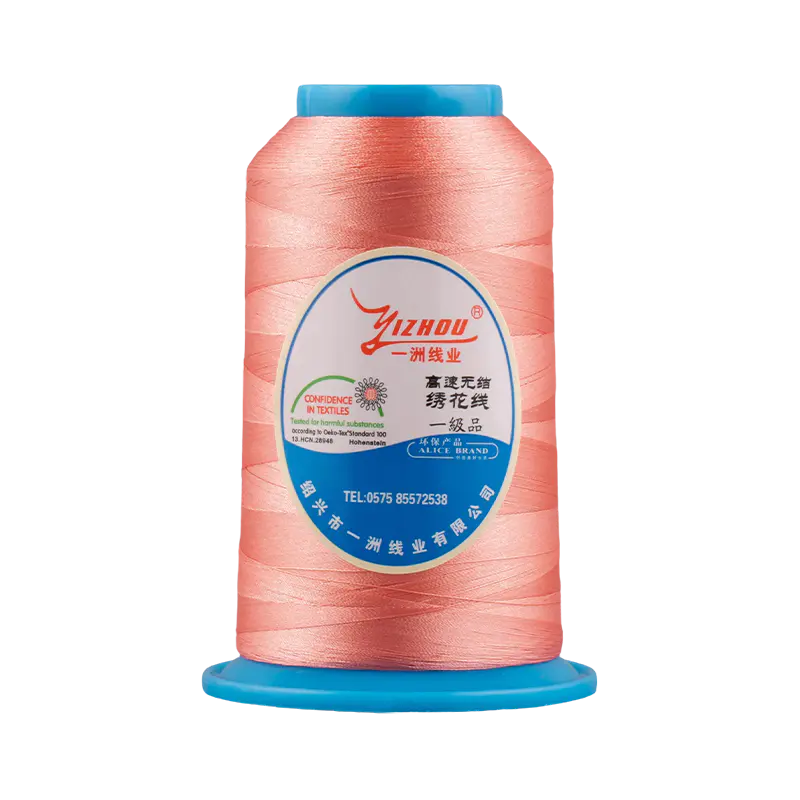 75D/2 Polyester Embroidery Thread for Fine DetailA fine polyester thread suited to small lettering, dense logos, and delicate fabrics where clean definition and reduced bulk matter.View Product →
For medium-weight production work, a 120D/2 polyester embroidery thread is a practical sweet spot. It has enough body for logos, outlines, and moderate fills on polo shirts, workwear, and bags, while still running cleanly on a well-maintained machine. It is not a universal answer for every fabric, but it is a sensible starting point when a buyer needs one thread that can cover a broad order mix without constant machine changes.
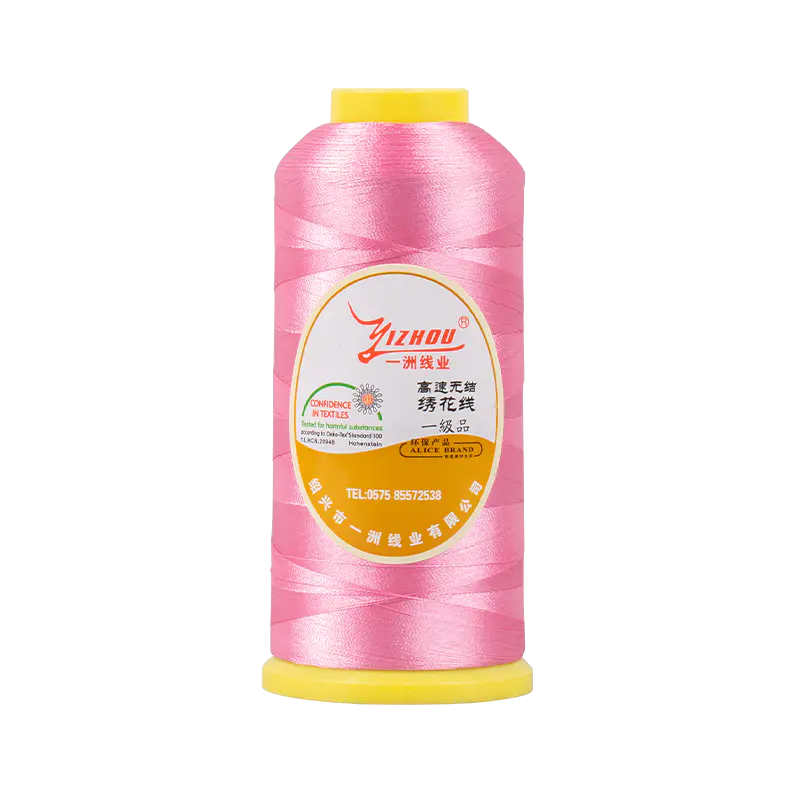 120D/2 Polyester Embroidery Thread for Medium-Weight ProductionA balanced all-purpose thread for logos, outlines, and moderate fills on uniforms, workwear, bags, and high-volume commercial embroidery.View Product →
Heavy fabrics call for a heavier thread. A 30-weight polyester or a 150D/2 polyester gives better coverage on denim, canvas, and thick fleece. The needle must be sized up, often to a 90/14 or 100/16, and the design density may need adjustment because heavy thread occupies more space. If the design is already dense, a heavier thread can push the fabric into puckering or create a stiff, board-like patch. The fix is not always “use heavier thread.” Sometimes it is “use a heavier thread only for the outline and keep the fill at 40-weight.”
What to check before a production run
Before committing a large order, run a stitch-out on the actual fabric with the actual backing, needle, and thread combination. Check for thread breaks, skipped stitches, loop formation, puckering, and color contrast. Run the sample through the same wash or dry-cleaning cycle the finished product will face. If the thread is going on a workwear garment that will be industrial laundered, that test is more important than the initial appearance. A thread that looks excellent on the machine but fades or abrades after ten washes is not a good production choice.
Also check the thread path. A polyester thread that runs well on one machine may run poorly on another if the tension discs are worn, the guides are grooved, or the bobbin case is set too tight. Thread performance is a system, not a single component. The best thread in the world will break if the needle is dull, the machine is out of time, or the operator keeps tightening the top tension to compensate for a bobbin problem. Fix the machine before blaming the thread.
Hand Embroidery: Cotton Floss Is the Best Starting Point
Hand embroidery is a different discipline. There is no needle heat from a machine running at 900 stitches per minute, and there is no rotary hook flexing the thread thousands of times per hour. The priorities shift toward softness, separation, color range, and how the thread behaves when pulled through fabric by hand. Six-strand cotton floss is the most common answer because it is widely available, easy to separate, and forgiving for beginners. It has a matte finish that suits traditional surface embroidery, cross-stitch accents, and floral work.
The “best” hand embroidery thread still depends on the project. On fine linen or cotton voile, one or two strands of cotton floss give delicate detail. On medium-weight cotton, three or four strands give better coverage. On heavy linen, felt, or wool, all six strands may be appropriate. The common mistake is using too many strands on a fine fabric. The stitches become bulky, the fabric puckers, and the design loses the lightness that hand embroidery is supposed to have.
Perle cotton is another strong choice for hand work when you want a slight sheen and a firmer twist. It is usually sold in sizes such as 8, 12, and 16, with smaller numbers indicating thicker thread. It does not separate into strands, so it is less flexible than floss, but it is excellent for outline stitches, French knots, and decorative borders. On the other hand, silk thread is the choice for heirloom work and silk shading because it has a natural luster and a smooth hand. It is more expensive and less forgiving, but the visual result is difficult to match with cotton.
For wool embroidery, crewel wool gives a warm, textured look that cotton cannot reproduce. It is thicker and fuzzier, so it works best on sturdy fabrics and designs that are not washed frequently. Metallic threads are a specialty choice. They add sparkle, but they fray, kink, and require shorter working lengths and a larger needle. They are not a good default for a beginner, and they are not a good choice for a production line that needs predictable throughput.
Practical hand-stitching rules
- Keep working lengths to about 18 inches; longer lengths abrade, pill, and tangle.
- Separate strands one at a time to reduce twisting and knotting.
- Use a needle with a eye large enough for the thread but small enough to avoid leaving visible holes.
- Do not over-wax cotton floss unless the fabric is rough; wax can attract dust and change the finish.
- Test the thread on a scrap of the same fabric, especially when using dark colors on light fabric.
If you are buying for a hand embroidery kit or a small studio, the best approach is to standardize on a six-strand cotton floss and add specialty threads only for specific designs. That keeps inventory simple and makes it easier to train new stitchers. If you are buying for a production studio that sells finished hand-embroidered goods, test colorfastness before committing. Cotton floss can be beautiful, but not all cotton floss is equally stable in washing or light exposure.
Weight, Ply, and Needle: The Three Variables That Cause Most Problems
Most embroidery thread problems come down to three variables: thread weight, thread ply, and needle size. Weight affects coverage and detail. Ply affects strength and smoothness. Needle size affects how the thread passes through the fabric and how much heat is generated. When these three are mismatched, the machine may break thread, skip stitches, create loops, or produce a design that feels too stiff or too thin.
A useful starting point is to match thread weight to fabric weight. For lightweight fabrics such as chiffon, voile, and fine knits, use a finer thread, such as 60-weight polyester or 75D/2, with a 65/9 or 70/10 needle. For medium-weight fabrics such as cotton shirting, polo, and poplin, use a 40-weight polyester or 120D/2 with a 75/11 or 80/12 needle. For heavy fabrics such as denim, canvas, and thick fleece, use a 30-weight polyester or 150D/2 with a 90/14 or 100/16 needle. These are starting points, not laws. The actual fabric finish, backing, and design density can move the recommendation up or down one step.
Ply is where buyers often get confused. A 120D/2 thread is a two-ply construction, but that does not mean it is weak. The two plies are twisted together to create a balanced thread. A balanced thread lies flat, feeds smoothly, and resists snarling. An unbalanced thread may twist back on itself, form loops, or create tension problems that no amount of machine adjustment can fully solve. When evaluating a new supplier, ask for a sample and run it at the speed you actually use. A thread that runs well at 600 stitches per minute may fail at 900. A thread that runs well on a single-head machine may behave differently on a twelve-head machine because the thread path and tension consistency differ.
Needle size is not a minor detail. A needle that is too small for the thread causes abrasion and breaks. A needle that is too large creates visible holes and can damage fine fabrics. A dull needle generates heat, which is especially damaging to polyester because it can soften or glaze the thread. In high-speed embroidery, needle heat is a real production issue. If you see thread breaks clustered around the same needle, check the needle point, the needle size, and the thread path before changing the thread.
A simple compatibility check
- Confirm the fabric weight and finish.
- Choose a thread weight that gives the needed coverage without excessive bulk.
- Select a needle size that creates a clean hole for that thread and fabric.
- Run a 5,000-stitch sample at production speed.
- Wash or dry-clean the sample using the final care method.
- Inspect for color change, abrasion, puckering, and stitch distortion.
This check takes less than an hour and prevents most costly production surprises. It is especially important when switching from a 120D/2 to a 150D/2 thread or from a standard polyester to a solution-dyed polyester. The chemical composition may be similar, but the running behavior and color performance can differ enough to require a new machine setting.
Colorfastness and Care: Where “Best” Becomes a Durability Question
For consumer goods, colorfastness is often the deciding factor. A thread can stitch beautifully and still fail the customer after three washes. The risk is higher with dark shades, saturated reds, and deep blues, especially when the thread is dyed after yarn formation. Package-dyed polyester can be excellent, but the dye penetration and fixation must be controlled. Solution-dyed, also called dope-dyed, polyester takes a different route: the color pigment is added before the fiber is formed. The color is part of the filament rather than a surface coating, which generally gives better color penetration and more consistent shade through the thread’s cross-section.
That does not mean every dope-dyed thread is automatically better. The pigment dispersion, spinning consistency, and final lubrication still matter. But for industrial programs where shade consistency and wash fastness are critical, dope-dyed polyester is often the more predictable choice. It also reduces the risk of shade variation between lots because the color is engineered into the polymer rather than applied in a separate dye bath. For buyers, the practical question is not “Is dope-dyed better?” It is “Does this supplier’s dope-dyed thread meet the colorfastness standard my customer requires?”
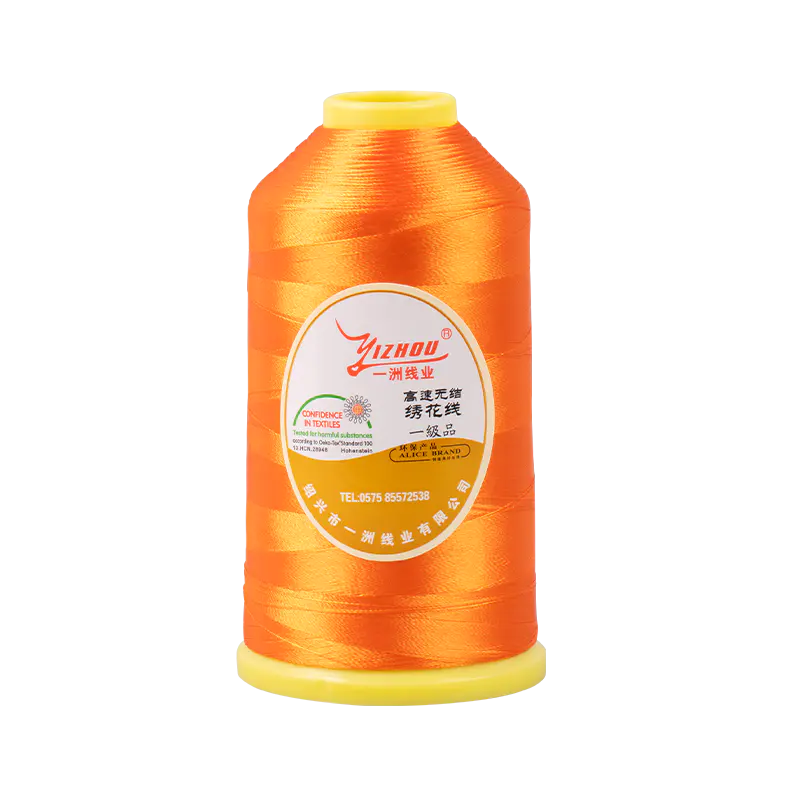 150D/2 Dope-Dyed Polyester Embroidery ThreadA solution-dyed thread for programs needing consistent shade, wash fastness, and reliable performance across apparel, uniforms, and promotional embroidery.View Product →
Ask for test reports that match the care method. For wash fastness, common methods include ISO 105-C06 and AATCC 61. For rubbing fastness, ISO 105-X12 and AATCC 8 are common. For lightfastness, ISO 105-B02 and AATCC 16 are common. Do not accept a generic “colorfast” statement. Ask which method was used, what rating was achieved, and whether the test was run on the final thread or on the base yarn. A rating of 4–5 on a 1–5 scale is generally strong for apparel, but the acceptable level depends on the end use. Workwear, outdoor products, and children’s items often require stricter performance than decorative home textiles.
Care instructions also affect thread choice. If the finished garment will be industrial laundered at high temperature with bleach, polyester is usually the safer choice than cotton or rayon. If the garment will be dry-cleaned, check solvent resistance and color bleeding. If the product will be exposed to sunlight for long periods, lightfastness matters as much as wash fastness. A thread that passes a wash test but fades in a window display is still a failure. Match the test to the real use, not to the lab’s easiest condition.
Shade consistency and lot control
Color is not just a chemical property; it is a production control issue. Two cones labeled “same color” can differ if they come from different dye lots. In a large order, that difference may appear as a visible band across a garment or a mismatch between the left and right sleeve. For critical programs, request lot-specific color approvals and keep a physical sample from each approved lot. If the supplier cannot control dye lots, the buyer should expect some variation and plan cutting and stitching accordingly. A good thread manufacturer will understand this and provide lot information, color cards, and batch traceability.
Buying Thread for Production: What B2B Buyers Should Specify
For a wholesale buyer, “best embroidery thread” is not only a performance question. It is a supply question. The thread must arrive on time, match the approved color, run consistently from cone to cone, and meet the customer’s care requirements. A thread that is marginally cheaper per kilogram but causes more breaks, more downtime, and more rejects is not cheaper at all. The true cost includes machine time, operator attention, replacement stitches, and delayed shipments.
Start with a clear specification. At minimum, specify fiber type, thread weight or denier, ply, color reference, put-up size, cone type, and expected end use. If the thread is for high-speed machine embroidery, state the machine speed and needle size used in production. If it is for hand embroidery, state the strand count and the desired finish. If the product will be washed, state the wash method and the required colorfastness rating. Suppliers cannot guarantee performance against an unstated requirement.
Ask for samples from the actual production lot, not from a showroom display. Run the samples on your own machine and with your own operators. Check the cone build: a poorly wound cone can cause tension spikes, especially near the end of the cone. Check the splice or knot count. A small number of knots may be acceptable for some programs and unacceptable for others, particularly in large fills where a knot can create a visible defect. Check the yardage or weight per cone and confirm that the tolerance is stated in the purchase order.
For buyers comparing thread specifications, a detailed comparison of 75D/2, 120D/2, and 150D/2 polyester embroidery thread can help separate fine-detail, general-purpose, and heavy-coverage programs before the sampling stage. It is easier to negotiate when you know which specification actually fits the design, rather than asking for three sizes and testing everything.
Procurement checklist
- Fiber and construction: polyester, 120D/2, two-ply, or the exact alternative.
- Color standard: physical swatch, color card reference, and acceptable tolerance.
- Colorfastness: wash, rub, light, and dry-cleaning methods as applicable.
- Put-up: cone weight or length, cone taper, and packaging.
- Running performance: stitch speed, needle size, and break-rate target.
- Lot control: dye lot labeling, batch traceability, and retention sample.
- Delivery: lead time, minimum order quantity, and packaging durability for export.
It also helps to evaluate the manufacturer, not just the thread. Ask how they control filament quality, twisting, lubrication, and color consistency. Ask what happens when a lot fails the color standard. A supplier that can explain its process is usually easier to work with than one that only quotes a price. For industrial programs, the ability to document process control is part of the product.
When comparing suppliers, it is worth reviewing how to evaluate high-quality polyester embroidery thread for industrial performance before you approve a bulk order. The evaluation should include more than a visual check. It should include stitch speed, break rate, color consistency, and care performance under the actual conditions the finished product will face.
Finally, do not ignore packaging and shipping. Embroidery thread is lightweight, but cones can deform if they are compressed in transit. Moisture can affect some fibers and packaging. A supplier that exports to many markets should understand pallet configuration, carton strength, and humidity protection. Those details are not glamorous, but they determine whether the thread arrives in usable condition.
Testing Before You Commit
The only reliable way to choose the best thread for a specific embroidery program is to test it under realistic conditions. A small stitch-out on a scrap of fabric is useful, but it is not enough. The test should include the actual fabric, backing, needle, machine speed, and finishing process. If the finished product will be washed, wash the sample. If it will be dried in a tumble dryer, dry it. If it will be exposed to sunlight, place it in a window for a representative period or request lightfastness data.
A practical test plan has five parts. First, run a design with small lettering, dense fill, and an outline. That combination exposes different failure modes. Second, run the design at production speed, not at a slow demonstration speed. Third, inspect the sample for thread breaks, skipped stitches, loops, puckering, and color bleed. Fourth, wash or dry-clean the sample according to the final care instructions. Fifth, compare the washed sample to the unwashed sample and check for color change, abrasion, shrinkage, and stitch distortion.
Record the results. Note the thread lot, needle size, machine speed, tension settings, backing, and wash method. If a problem appears, you need that information to isolate the cause. A thread break may come from the thread, the needle, the tension, the thread path, or the operator. Without records, you are guessing. With records, you can compare suppliers and make a decision based on evidence.
Common defects and likely causes
- Thread breaks at the needle: needle too small, needle dull, thread path damaged, or thread too heavy for the fabric.
- Loops on the surface: top tension too low, bobbin tension too loose, or thread feeding inconsistently.
- Puckering: backing insufficient, stitch density too high, or thread weight too heavy for the fabric.
- Color bleeding: dye fixation poor or care method harsher than the thread can tolerate.
- Fuzzy or frayed thread: filament damage, poor lubrication, or excessive abrasion in the thread path.
- Visible knots or splices: supplier’s winding or splicing standard does not match the order requirement.
If the defect appears only with one color, suspect the dye process or the lot. If it appears with all colors, suspect the machine, needle, or thread specification. If it appears only at high speed, suspect needle heat, thread tension, or thread finish. This kind of diagnosis is faster than trial-and-error replacement, and it protects the buyer from switching to a more expensive thread that solves the wrong problem.
Common Mistakes That Make Good Thread Perform Badly
Many thread failures are not thread failures at all. They are system failures. The most common mistake is using the wrong needle. A 40-weight polyester thread run through a needle that is too small will abrade, heat up, and break. A 75D/2 fine thread run through a needle that is too large may create visible holes and unstable stitches. The needle should create a clean passage for the thread without damaging the fabric.
The second common mistake is over-tightening the top tension to compensate for a bobbin problem. This flattens the thread, increases friction, and causes breaks. The third is using a worn or grooved thread guide. A small groove may look harmless, but it acts like a blade on fine polyester filaments. The fourth is storing thread in direct sunlight or in a humid area. UV exposure can fade colors, and moisture can affect some fibers and lubricants. The fifth is mixing dye lots without checking. Two cones of the same color name can be visibly different when stitched side by side.
Another frequent mistake is choosing thread by color alone. A beautiful shade is useless if the thread cannot survive the wash or the stitch speed. Buyers should qualify the thread on performance first, then select the color from a qualified product family. That approach is especially important for promotional products, uniforms, and workwear, where the cost of a failed order is much higher than the cost of a slightly better thread.
Finally, do not assume that a heavier thread is always stronger or better. A 150D/2 thread may be stronger in absolute terms than a 75D/2 thread, but it can also be too heavy for the design, causing stiffness and puckering. The best thread is the one that matches the job. That is why a specification sheet with more than a weight number is so valuable. Fiber, ply, elongation, lubrication, colorfastness, and recommended needle size all matter.
Bottom Line
If you need one practical answer, choose a 40-weight polyester thread for general machine embroidery, a 60-weight polyester or 75D/2 for fine detail, and a 30-weight polyester or 150D/2 for heavy coverage. For hand embroidery, start with six-strand cotton floss, then move to perle cotton, silk, or wool depending on the texture and sheen you want. For color-critical production, solution-dyed polyester is often the safer choice because the color is built into the fiber rather than applied as a surface dye.
The best thread is not the most expensive one or the one with the widest color card. It is the one that runs consistently on your machine, matches your fabric and design, passes the care test, and arrives with the same performance lot after lot. That is a specification decision, not a shopping decision. Once you define the end use, the needle, the stitch speed, and the wash method, the short list becomes much shorter, and the right thread becomes much easier to defend.